Rose oil has been treasured for centuries for its rich floral aroma and its many uses in skincare, aromatherapy, and personal care. Among the world’s best-known varieties is Bulgarian rose oil, traditionally produced from the fragrant petals of Rosa damascena grown in Bulgaria’s famous Rose Valley.
So, what are the benefits of rose oil, and how can you actually use it? Rose oil is commonly used to add fragrance to skincare products, create relaxing aromatherapy blends, enhance massage oils, and bring the unmistakable scent of fresh roses into everyday routines. Because pure rose essential oil is highly concentrated, however, knowing how to dilute and use it properly is important.
In this guide, we’ll explore the benefits of rose oil, the most practical ways to use it, what makes Bulgarian rose oil special, and what you should know before applying it to your skin or adding it to your aromatherapy routine.
You’ll also learn how rose oil differs from rose water and rosehip oil, how to recognize a quality product, and why Bulgaria has become so closely associated with some of the world’s most prized rose oil.
What Is Rose Oil?
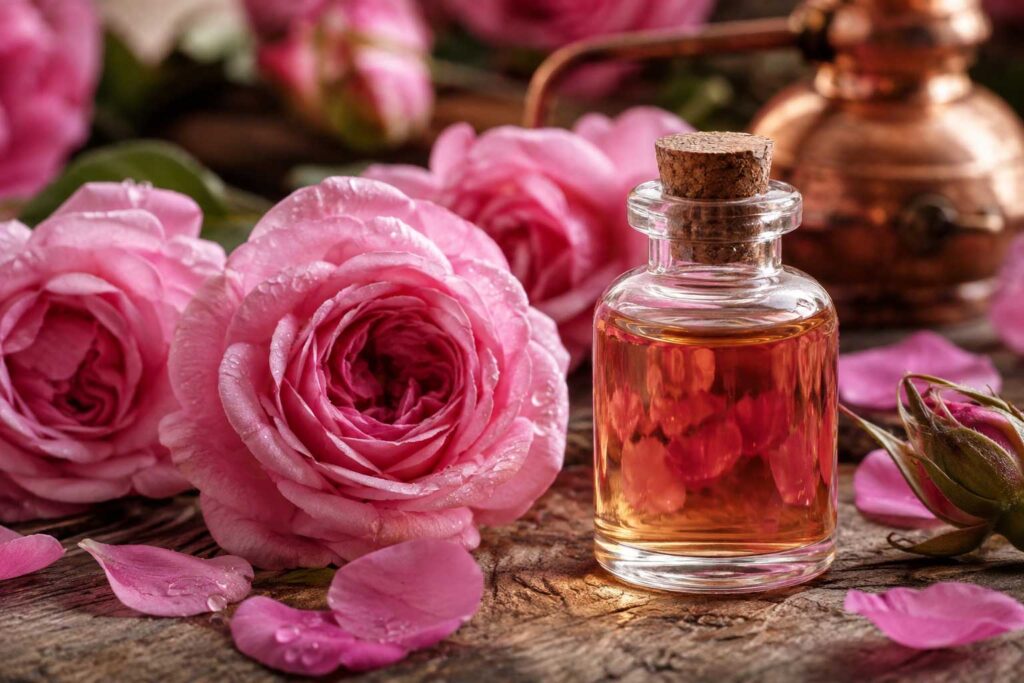
Rose oil, often called rose essential oil or rose otto, is a highly concentrated aromatic oil produced from fresh rose petals. One of the most prized varieties comes from Rosa damascena, the Damask rose traditionally cultivated in Bulgaria.
Bulgarian rose oil is especially associated with the Rose Valley, a region between the Balkan Mountains and Sredna Gora where roses have been cultivated for generations. The area’s climate and long rose-growing tradition have helped make Bulgaria internationally known for rose production.
Producing pure rose oil requires an enormous quantity of flowers. The roses are traditionally harvested early in the morning and processed soon after picking to preserve their quality and fragrance. Traditional Bulgarian rose oil is obtained primarily through steam distillation.
The finished oil is intensely fragrant, so only a very small amount is normally needed. Its aroma is floral, rich, slightly sweet, and considerably more complex than the scent of many artificial rose fragrances.
Is Rose Oil the Same as Rose Essential Oil?
The terms rose oil and rose essential oil are often used interchangeably when referring to the concentrated aromatic oil obtained from rose petals.
However, product labels deserve a closer look. Some products marketed simply as “rose oil” may actually contain rose fragrance, diluted essential oil, or rose extract blended with a carrier oil.
If you’re looking for authentic rose essential oil, check the ingredient list and botanical name. Rosa damascena flower oil is the ingredient most closely associated with traditional Bulgarian rose oil.
This is also different from rosehip oil, which is pressed from the fruit and seeds of the rose plant rather than distilled from its petals. Rosehip oil has different properties, uses, and aroma.
You can’t make something beautiful with force.
Popular Bulgarian Proverb
How Is Rose Oil Made?
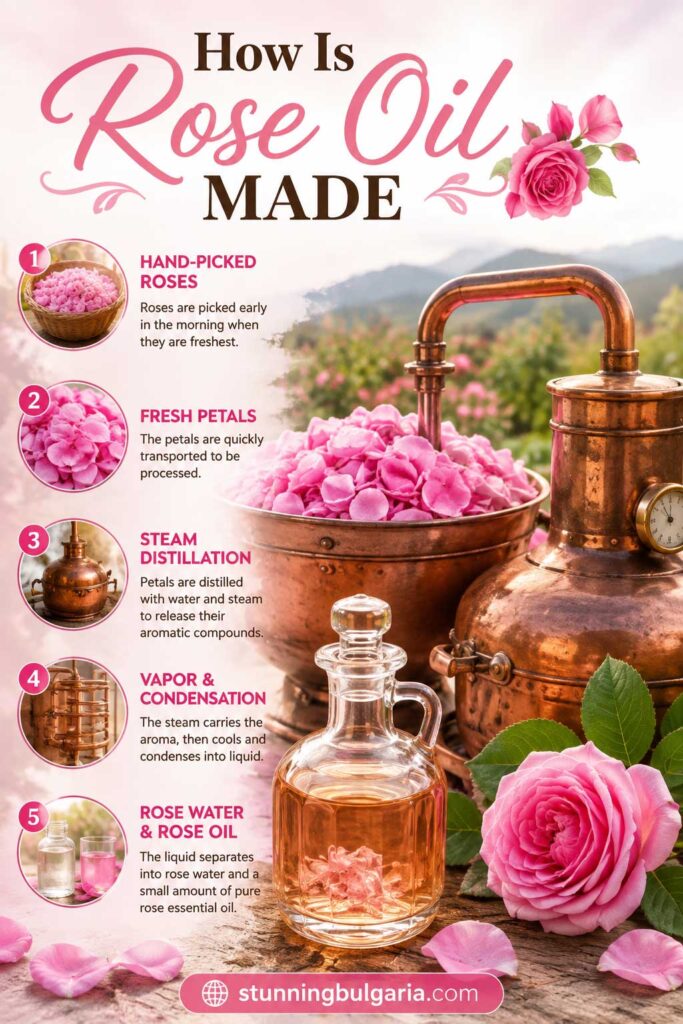
Rose oil is produced from fresh rose petals, with Rosa damascena—the Damask rose—being the variety most closely associated with traditional Bulgarian rose oil. Another important species used in rose products is Rosa centifolia, sometimes called the cabbage or Provence rose.
Two different rose ingredients are particularly common in cosmetics and perfumery:
- Rose otto: An essential oil traditionally obtained through steam or water distillation of fresh rose petals.
- Rose absolute: A highly aromatic extract produced using a different extraction process and widely used in fine fragrances and perfumery.
How Bulgarian Rose Oil Is Traditionally Produced
In Bulgaria, the process begins in the rose fields during the short flowering season, typically in late spring and early summer.
Rose picking traditionally starts early in the morning, when the flowers are fresh and their aromatic compounds are well preserved. The blossoms are picked by hand and transported for processing as quickly as possible.
The fresh petals are then distilled with water and steam. As the aromatic compounds are released from the flowers, the vapor is cooled and condensed. The resulting liquid separates into fragrant rose water and a very small quantity of precious rose essential oil.
Why Does Rose Oil Cost So Much?
Producing rose oil requires an extraordinary amount of plant material. Thousands of freshly picked roses may be needed to produce only a small quantity of essential oil.
The flowers also have to be harvested during a relatively short season, much of the picking is still done by hand, and the roses need to be processed quickly after harvesting.
This combination of large quantities of flowers, manual harvesting, a short production season, and low essential-oil yield helps explain why genuine Bulgarian rose oil can be considerably more expensive than many other essential oils.
It also explains why Bulgaria’s Rose Valley has become so important. Generations of experience growing Rosa damascena and distilling its petals have turned rose oil into one of Bulgaria’s most recognizable traditional products.
The Main Roses Used for Rose Oil
Several rose species are cultivated around the world, but two are particularly important for producing rose oil and other aromatic rose extracts:
- Rosa damascena (Damask rose)– The species most strongly associated with Bulgarian rose oil. It is extensively cultivated in Bulgaria’s Rose Valley and is also grown in countries including Turkey, Iran, India, and other rose-producing regions.
- Rosa centifolia (cabbage or Provence rose) – Another highly fragrant rose traditionally cultivated for perfumery and aromatic extracts, particularly in countries such as France and Morocco.
For Bulgaria, Rosa damascena is the star. Its intensely fragrant flowers have been cultivated for generations, and the rose has become closely connected with the history, culture, and identity of Bulgaria’s famous Rose Valley.
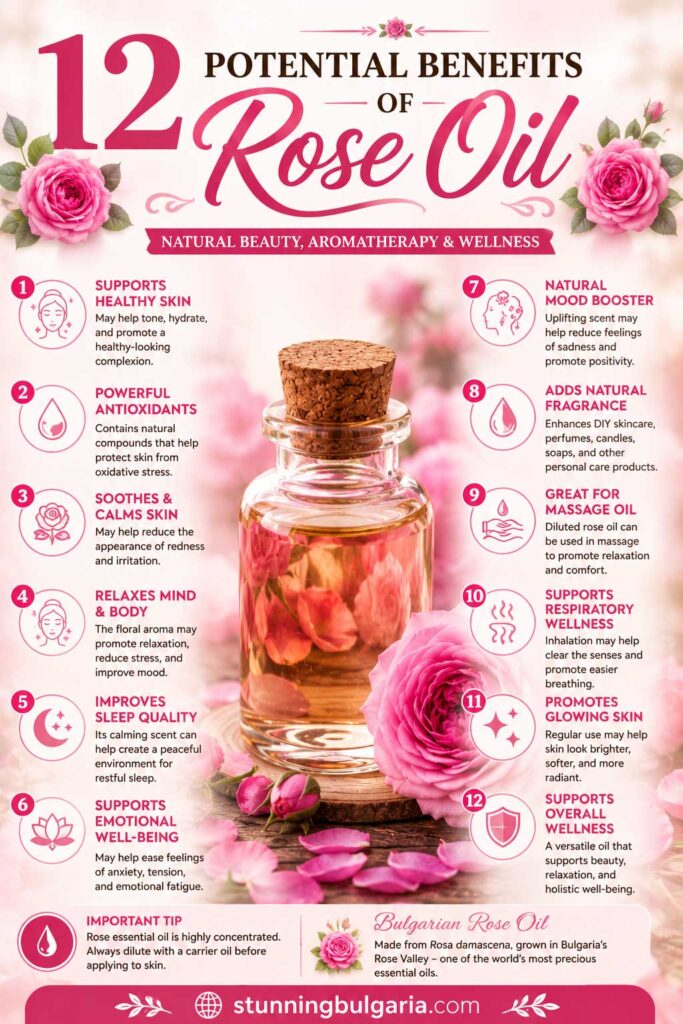
12 Potential Benefits of Rose Oil
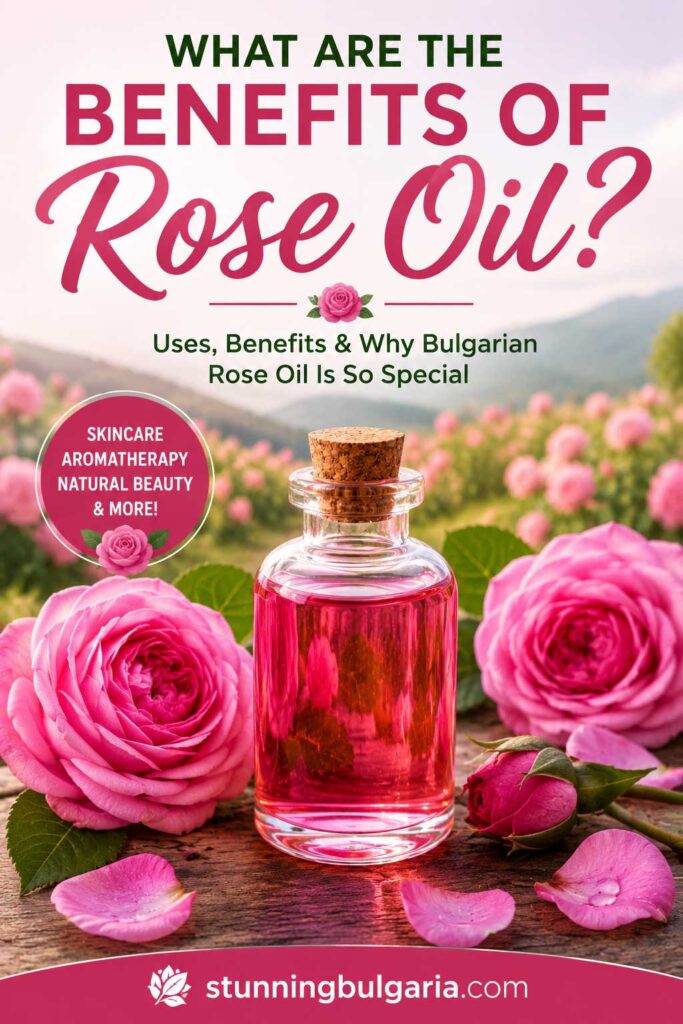
The benefits of rose oil go well beyond its beautiful fragrance. For centuries, rose preparations have been used in traditional beauty and wellness practices, while today rose essential oil is most commonly found in aromatherapy, skincare, massage oils, perfumes, and personal-care products.
Modern research has also explored some of the compounds and potential effects associated with rose essential oil. However, evidence varies considerably depending on the claimed benefit. Rose oil should be viewed as a complementary wellness or cosmetic ingredient rather than a treatment for a medical condition.
Here are some of the most interesting potential benefits of rose oil and the ways it is commonly used today.
Bulgaria is one of the world’s leading producers of rose oil and has been reported to supply around 70% of global rose oil production. Bulgarian rose oil is highly valued by the international fragrance and cosmetics industries.
1. May Promote Relaxation
One of the best-known uses of rose essential oil is aromatherapy. Its rich floral fragrance is commonly used when creating a peaceful, relaxing atmosphere at home.
You can experience the aroma through a diffuser or by using properly diluted rose oil as part of a massage or personal-care routine.
For many people, this is one of the simplest benefits of rose oil to enjoy. You don’t need a complicated routine—sometimes the fragrance itself is the reason for using it.
2. May Help Reduce Feelings of Stress and Anxiety
Researchers have investigated whether inhaling rose aroma or using rose oil during massage may influence feelings of stress and anxiety.
Some small studies have reported promising results, but the available evidence is still limited. Rose oil shouldn’t replace professional care for anxiety or other mental-health conditions.
Instead, think of its fragrance as something that may complement relaxing activities such as meditation, a warm bath, massage, reading, or an evening wind-down routine.
A 2004 study published in Pharmacology Biochemistry and Behavior also investigated the potential anxiolytic effects of rose oil.
3. Has Demonstrated Antimicrobial Activity in Laboratory Research
Rose essential oil contains naturally occurring aromatic compounds that have attracted attention for their antimicrobial properties.
Laboratory research has found activity against certain microorganisms, although results obtained in a laboratory don’t automatically mean that rose oil can prevent or treat infections in people.
This distinction is important. Older descriptions of the benefits of rose oil sometimes make very broad claims about treating infections. Current evidence doesn’t justify using rose essential oil as a replacement for appropriate medical treatment.
4. Can Be Incorporated Into a Skincare Routine
Rose oil is widely used in cosmetic and skincare formulations. You’ll find rose-derived ingredients in facial oils, moisturizers, serums, soaps, creams, and luxury beauty products.
At home, rose essential oil can also be added in very small amounts to an appropriate carrier oil.
Because pure essential oils are highly concentrated, rose essential oil should generally be diluted before topical use. A patch test is also sensible when trying a new product, particularly if you have sensitive skin.
5. May Help Soothe the Appearance of Dry Skin
Rose oil is often included in products designed for dry or mature-looking skin, particularly when combined with moisturizing carrier oils and other emollient ingredients.
It is important to distinguish between the essential oil and the carrier oil, however. A diluted rose blend may feel moisturizing largely because of the jojoba, almond, or other carrier oil used as its base.
Rose essential oil contributes primarily its aromatic compounds and characteristic fragrance.
6. May Be Useful in Products for Acne-Prone Skin
You may also encounter rose oil in skincare products formulated for blemish-prone skin.
Its potential antimicrobial and antioxidant properties are among the reasons researchers and cosmetic formulators have taken an interest in rose-derived compounds.
That doesn’t mean pure rose essential oil should be applied directly to pimples. Undiluted essential oils can irritate the skin, potentially making an existing problem worse.
If you want to experiment with rose oil for skin, choose a properly formulated cosmetic product or dilute the essential oil appropriately before use.
7. Contains Naturally Occurring Antioxidant Compounds
Roses contain numerous naturally occurring plant compounds, and researchers have investigated different rose extracts and essential oils for antioxidant activity.
Antioxidants are interesting in skincare because they interact with processes associated with oxidative stress. However, research involving isolated compounds or laboratory tests shouldn’t be interpreted as proof that rose oil prevents disease or dramatically reverses skin aging.
For everyday use, its antioxidant properties are better viewed as one reason rose-derived ingredients continue to attract interest in cosmetic formulations.
8. May Complement a Mature-Skin Routine
Rose has a long association with beauty products intended for mature skin, and you’ll frequently find it in facial oils, creams, masks, toners, and serums.
Rather than thinking of rose oil as an “anti-aging cure,” consider it one ingredient that can complement a broader skincare routine.
Sun protection, adequate hydration, gentle cleansing, moisturization, sleep, and overall lifestyle habits remain much more important for maintaining healthy-looking skin.
Still, the combination of its fragrance and use in carefully formulated skincare products makes this one of the most popular rose oil benefits for skin.
9. May Help With Menstrual Discomfort When Used in Aromatherapy or Massage
Rose oil has traditionally been associated with women’s wellness, and some research has explored aromatherapy and essential-oil massage for menstrual discomfort.
A diluted rose massage blend can be incorporated into a relaxing self-care routine. However, it shouldn’t be presented as a treatment for menstrual disorders or unexplained pain.
10. Makes a Beautiful Addition to Massage Oils
Rose essential oil works particularly well in massage blends because only a tiny amount is needed to give a carrier oil a noticeable floral fragrance.
Jojoba, sweet almond, grapeseed, and other suitable carrier oils can provide the base, while a properly diluted amount of rose essential oil provides its distinctive aroma.
Rose also blends beautifully with other fragrances, including lavender, geranium, bergamot, sandalwood, and certain citrus essential oils.
Always check the individual safety recommendations for every essential oil included in a blend.
11. Adds Natural Rose Fragrance to Personal-Care Products
Fragrance is one of the most obvious yet sometimes overlooked benefits of rose oil.
Authentic rose essential oil has an extraordinarily complex aroma. Rather than smelling simply “sweet,” a quality oil can have deep floral, warm, fresh, slightly spicy, and even subtly green notes.
This complexity has made rose one of the classic ingredients of fine perfumery.
Rose oil can also be found in soaps, body oils, creams, bath products, candles, and other scented products. If you’d like to see some examples, we’ve rounded up the top products using Bulgarian rose oil and what makes each one worth considering. Because the essential oil is so concentrated, you need relatively little to create a recognizable rose aroma.
12. Can Turn an Everyday Routine Into a Relaxing Ritual
Not every benefit needs to be medicinal.
Adding the fragrance of rose to a bath, massage oil, diffuser, or evening skincare routine can make an ordinary part of the day feel more enjoyable.
This sensory experience is a major reason rose has remained important in cosmetics and perfumery for centuries.
And when the oil comes from Rosa damascena grown in Bulgaria, there is an additional cultural connection. Bulgarian rose oil represents generations of rose cultivation, early-morning flower harvesting, and traditional distillation in one of Bulgaria’s most famous agricultural regions.
That combination of fragrance, tradition, versatility, and concentration helps explain why genuine Bulgarian rose oil continues to be one of the country’s most distinctive natural products.
How to Use Rose Oil

Rose oil is extremely concentrated, so a little goes a long way. The best way to use it depends on what you want from it—its fragrance, a relaxing aromatherapy experience, or an addition to your skincare or massage routine.
Here are some of the most practical ways to use rose essential oil at home.
Use Rose Oil in a Diffuser
One of the easiest ways to enjoy rose oil is with an essential-oil diffuser. Its rich floral aroma can quickly fill a room and create a pleasant, relaxing atmosphere.
Follow the instructions provided with your diffuser and start with a small amount. Rose oil has a powerful fragrance, so you may find that you need less than you would with some other essential oils.
Rose blends particularly well with lavender, geranium, sandalwood, bergamot, and other floral or woody aromas.
Inhale the Aroma
You don’t necessarily need a diffuser to enjoy the fragrance of rose oil.
A small amount can be used with an aromatherapy inhaler or another product specifically designed for essential-oil inhalation. Avoid putting concentrated essential oil directly inside your nose or near your eyes.
This can be a convenient way to enjoy the aroma while traveling or whenever using a room diffuser isn’t practical.
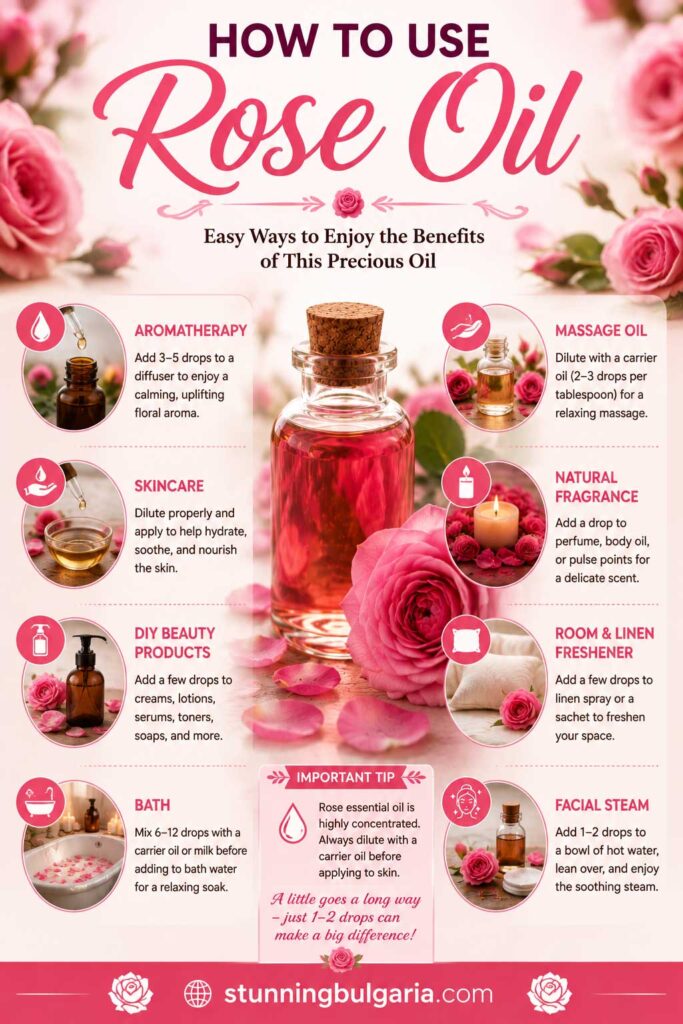
Make a Rose Massage Oil
Rose essential oil can be diluted in a carrier oil to create a beautifully fragrant massage blend.
Suitable carrier oils include:
- Jojoba oil
- Sweet almond oil
- Grapeseed oil
- Fractionated coconut oil
Because essential oils are concentrated, don’t apply pure rose essential oil directly over large areas of skin. Follow appropriate dilution guidance for the specific product you’re using.
Add Rose Oil to a Bath
A warm bath and the fragrance of roses make a natural combination, but essential oil shouldn’t simply be poured directly into bathwater.
Oil and water don’t mix, which means undiluted droplets can remain on the surface and come into direct contact with your skin.
Instead, use a properly formulated rose bath product or dilute the essential oil in an appropriate bath or body product designed to disperse essential oils safely.
Use Rose Oil in Your Skincare Routine
Rose oil is found in many facial oils, moisturizers, serums, creams, and other skincare products.
For the easiest option, choose a professionally formulated product that already contains rose essential oil at an appropriate concentration.
If you’re creating your own facial oil, dilute rose essential oil carefully in a skin-compatible carrier oil and patch-test the mixture before applying it more widely.
Use Rose Oil as a Natural Fragrance
The complex aroma of Rosa damascena is one reason rose oil has been prized in perfumery for centuries.
Properly diluted rose oil can be incorporated into personal fragrance blends, scented body oils, soaps, creams, and other cosmetic preparations.
Authentic Bulgarian rose oil is particularly concentrated, so even a very small amount can provide a noticeable rose fragrance.
Add Rose Oil to an Evening Self-Care Routine
Rose oil doesn’t have to serve a complicated purpose. Sometimes its greatest appeal is simply its fragrance.
Using a rose-scented skincare product, diffuser, massage blend, or bath product in the evening can turn an ordinary routine into something more enjoyable.
The distinctive scent of Bulgarian Rosa damascena also provides a small connection to the rose fields and centuries-old rose-growing traditions of Bulgaria.
Simple Rose Face and Body Moisturizer
- ½ cup of shea butter
- 2 tablespoons of Rose Water
- 1 teaspoon of raw honey
- 10 drops of Rose Essential Oil
Gently soften the shea butter using a double-boiler method, then remove it from the heat. Allow it to cool slightly before adding the rose water, honey, and rose essential oil.
Whisk until the mixture becomes smooth and creamy, then transfer it to a clean glass container.
Before using it more widely, test a small amount on your skin. Because this homemade moisturizer contains water and doesn’t include a preservative system, make small batches and don’t treat it like a shelf-stable commercial cosmetic.
Rose Oil Safety and Precautions
Rose essential oil is highly concentrated, and using more doesn’t necessarily provide greater benefits. A few basic precautions can help you enjoy rose oil safely while reducing the risk of skin irritation or other unwanted reactions.
Always Dilute Rose Essential Oil for Skin Use
Avoid applying large amounts of undiluted rose essential oil directly to your skin. Instead, dilute it in an appropriate carrier oil or use a professionally formulated skincare product that already contains rose oil at a suitable concentration.
Common carrier oils include jojoba, sweet almond, grapeseed, and fractionated coconut oil.
Do a Patch Test First
Before using a new rose oil blend over a larger area, test a small amount of the diluted product on a limited area of skin.
Stop using it if you experience burning, significant redness, itching, swelling, or another unexpected reaction.
Keep Rose Oil Away From Your Eyes
Essential oils can cause significant irritation if they come into contact with sensitive areas.
Keep rose oil away from your eyes, the inside of your nose, and other sensitive tissues. Wash your hands after handling concentrated essential oils.
Be Careful When Using Rose Oil Around Children and Pets
Essential oils shouldn’t automatically be assumed to be safe for everyone simply because they’re natural.
If you plan to diffuse or use rose essential oil around babies, young children, or pets, check appropriate safety guidance for your specific situation and avoid leaving concentrated oils where they can be accidentally swallowed.
Pregnancy and Breastfeeding
If you’re pregnant or breastfeeding, speak with a qualified healthcare professional before using concentrated essential oils, particularly if you plan to use them regularly or topically.
Don’t Use Rose Oil as a Substitute for Medical Treatment
Rose essential oil may be enjoyable as part of aromatherapy, skincare, massage, or a personal wellness routine, but it shouldn’t replace appropriate medical care.
Claims that rose oil can cure infections, treat serious diseases, “purify the blood,” stop significant bleeding, or treat organ disorders go beyond what current evidence supports.
Can You Eat Rose Essential Oil?
Don’t assume an essential oil is safe to consume simply because roses themselves can be used in food.
Essential oils are highly concentrated products, and their composition and intended uses vary. Unless a product is specifically manufactured and labeled for an appropriate food use, don’t add rose essential oil to drinks, foods, capsules, or homemade remedies for internal consumption.
For culinary rose flavor, products specifically intended for food—such as food-grade rose water—are generally a more appropriate choice.
When in doubt, follow the manufacturer’s directions for the specific rose product you have.
Rose Oil vs. Rosehip Oil vs. Rose Water
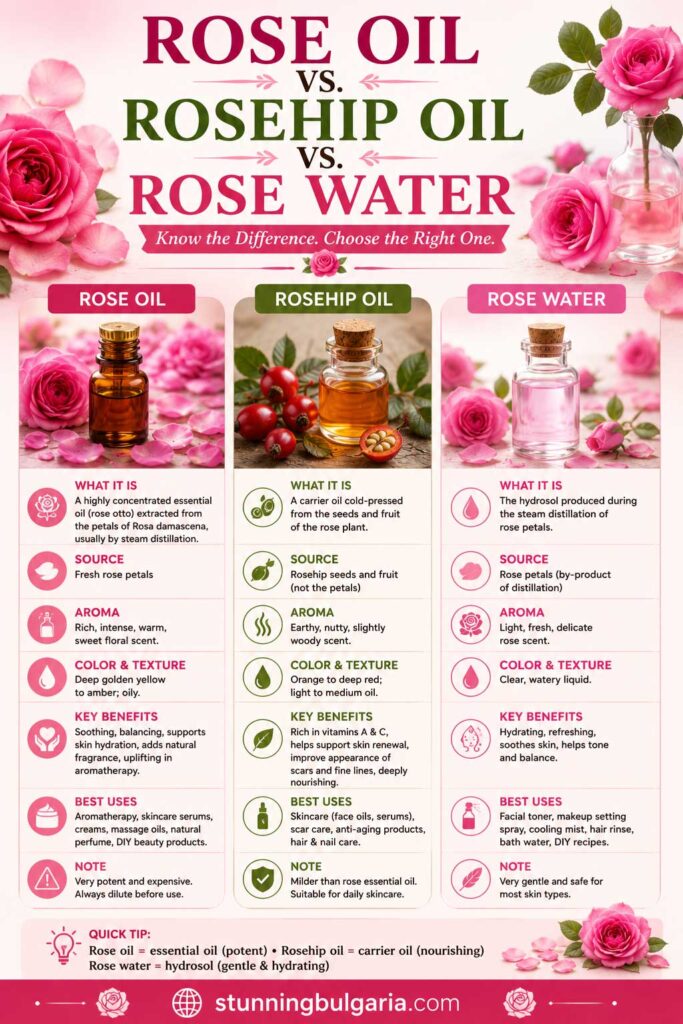
Rose oil, rosehip oil, and rose water are not the same product. Although all three come from roses and are commonly used in beauty and personal care, they are produced differently and have very different characteristics.
Understanding the difference is especially important when shopping for authentic Bulgarian rose oil, since products labeled with the word “rose” can vary considerably.
Rose Essential Oil
Rose essential oil, also known as rose otto, is the highly concentrated aromatic oil obtained from rose petals. Bulgarian rose oil is traditionally produced from Rosa damascena flowers through distillation.
It has an intense, complex floral aroma and is used primarily in:
- Aromatherapy
- Perfumery
- Massage blends
- Skincare and cosmetics
- Scented personal-care products
Because it is so concentrated, only a very small amount is normally needed, and it should be appropriately diluted before widespread topical use.
Rosehip Oil
Rosehip oil doesn’t come from rose petals. It is obtained from the fruits and seeds that develop after certain rose flowers have finished blooming.
Unlike rose essential oil, rosehip oil is a fatty plant oil rather than a concentrated essential oil. It is widely used as a facial and body oil because of its naturally occurring fatty acids and other plant compounds.
Rosehip oil also doesn’t have the intense floral fragrance people normally associate with roses.
So if you purchase rosehip oil expecting the powerful scent of Bulgarian rose essential oil, you’ll probably be surprised.
Rose Water
Rose water is an aromatic water associated with the distillation of rose petals. In Bulgaria, it is another traditional product closely connected with Rosa damascena.
Rose water is much less concentrated than rose essential oil and has a softer rose fragrance.
Depending on how a particular product is manufactured and formulated, rose water can be found in:
- Facial sprays and toners
- Cosmetic products
- Soaps and body-care products
- Perfumes and fragrances
- Culinary products specifically manufactured for food use
Always check the label because cosmetic rose water and rose water intended for food are not necessarily interchangeable.
Which Rose Product Should You Choose?
The best option depends on how you plan to use it.
Choose rose essential oil when you want an intensely concentrated rose aroma for aromatherapy, fragrance, or properly diluted topical blends.
Choose rosehip oil when you’re primarily looking for a plant-based carrier or facial oil without the characteristic strong rose fragrance.
Choose rose water when you want a much lighter rose product for skincare, fragrance, or—when specifically labeled for culinary use—food and drinks.
All three can be useful, but authentic Bulgarian rose oil is the product most closely associated with the traditional distillation of Bulgaria’s famous Damask roses.
Why Is Bulgarian Rose Oil So Special?
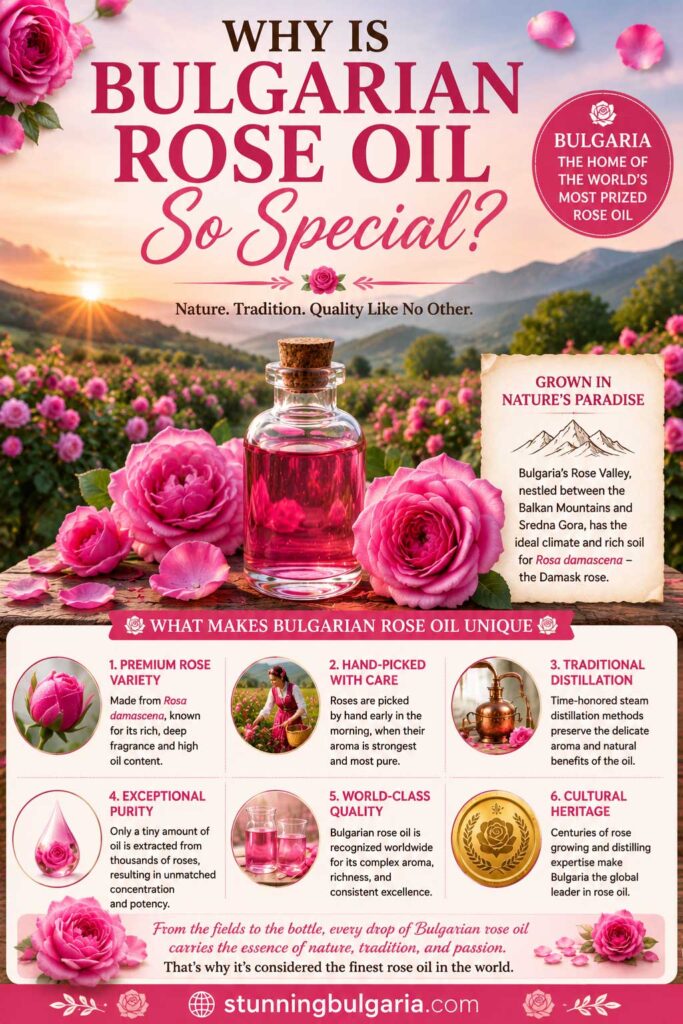
Bulgaria has become one of the countries most closely associated with high-quality rose oil, particularly oil produced from Rosa damascena, the fragrant Damask rose.
The heart of this tradition is Bulgaria’s famous Rose Valley, an area around Kazanlak and Karlovo where roses have been cultivated for generations. Each year during the flowering season, fields across the valley turn shades of pink as millions of roses begin to bloom.
But Bulgarian rose oil’s reputation isn’t based on appearance alone.
The Climate of Bulgaria’s Rose Valley
The Rose Valley lies between mountain ranges that help create favorable conditions for growing Rosa damascena.
The combination of seasonal temperatures, moisture, soils, and the valley’s protected location has allowed rose cultivation to become deeply established in this part of Bulgaria.
Over generations, local growers have developed considerable experience with planting, maintaining, harvesting, and processing roses specifically for aromatic products.
Roses Are Picked Early in the Morning
During the rose harvest, picking traditionally begins early in the morning.
Fresh blossoms are collected by hand and transported for processing as quickly as possible. Timing matters because the flowers are being grown specifically for their valuable aromatic compounds.
Seeing the harvest in person is one of the most memorable experiences visitors can have in Bulgaria’s Rose Valley.
Generations of Rose-Growing Tradition
Rose production isn’t simply another agricultural industry in Bulgaria. It has become part of the cultural identity of communities throughout the Rose Valley.
Knowledge of growing and processing roses has been passed through generations, while rose-related traditions continue to be celebrated in towns and villages across the region.
The annual Rose Festival in Kazanlak is perhaps the best-known example, bringing together rose-picking traditions, music, costumes, parades, and celebrations during the flowering season.
It Takes an Enormous Number of Roses to Produce the Oil
One reason genuine Bulgarian rose oil is so valuable is the extraordinary amount of plant material required to produce it.
A huge quantity of freshly harvested petals yields only a small amount of essential oil. Add hand harvesting, a short flowering season, rapid transportation, and careful distillation, and it becomes easier to understand why authentic rose oil commands a high price.
Bulgarian Rose Oil Is More Than an Essential Oil
For visitors to Bulgaria, rose oil tells a much larger story.
It connects the pink rose fields of the Rose Valley with traditional agriculture, generations of local knowledge, Bulgarian perfumery and cosmetics, and celebrations such as the Kazanlak Rose Festival.
That is what makes Bulgarian rose oil especially relevant to Stunning Bulgaria. It isn’t simply a fragrant product—it’s part of the landscape, traditions, and cultural heritage of one of Bulgaria’s most distinctive regions.
Why Is Bulgarian Rose Oil So Expensive?
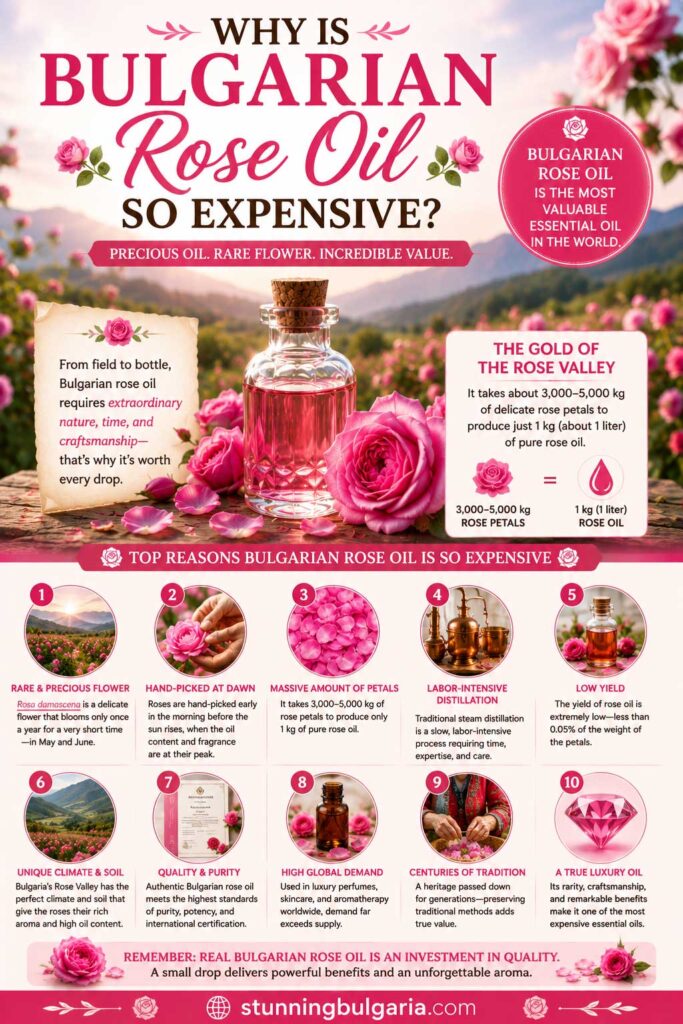
If you’ve ever shopped for authentic Bulgarian rose oil, the price can be surprising. A tiny bottle can cost considerably more than many other essential oils, but there are good reasons for that.
The biggest factor is simple: roses contain very little essential oil. Producing even a small quantity requires an enormous amount of fresh Rosa damascena blossoms, along with careful harvesting and distillation.
Thousands of Roses Produce Only a Small Amount of Oil
Rose petals may be intensely fragrant, but only a tiny fraction of their weight becomes essential oil during distillation.
Depending on the harvest and production conditions, several thousand kilograms of rose blossoms may be required to produce around one kilogram of rose oil.
That exceptionally low yield is one of the main reasons genuine rose oil is so valuable.
The Roses Are Picked by Hand
In Bulgaria’s Rose Valley, the harvest takes place during a relatively short flowering season.
The delicate blossoms are traditionally picked by hand early in the morning and transported for processing soon afterward. Harvesting such large quantities of flowers in a limited amount of time requires considerable labor.
Much of the Bulgarian rose harvest still depends on careful hand-picking, which adds both time and labor to the production process.
The Harvest Season Is Short
Rosa damascena doesn’t provide a year-round supply of flowers.
The main Bulgarian rose harvest generally lasts only several weeks in late spring and early summer, with timing changing according to weather conditions.
That leaves producers only a few weeks to harvest and process huge quantities of fresh roses.
Distillation Requires Time and Expertise
Once harvested, the roses need to be processed quickly.
Traditional Bulgarian rose oil is produced through distillation, requiring large quantities of flowers, water, specialized equipment, energy, and experienced producers who understand how to handle the delicate raw material.
All of this adds to the cost long before the finished rose oil reaches a bottle.
Authentic Bulgarian Rose Oil Is Highly Concentrated
A small bottle may look expensive, but rose essential oil is extremely concentrated. Only a tiny amount is normally needed for aromatherapy, fragrance, or a properly diluted topical blend.
This is also why unusually cheap products deserve a closer look. Some inexpensive products sold as “rose oil” may actually be diluted oils, fragrance blends, or products containing only a small amount of genuine rose essential oil.
Global Demand Adds to Its Value
Bulgarian rose oil is used in fine perfumery, cosmetics, skincare, aromatherapy, and other fragrance products around the world.
Demand for high-quality natural rose oil combined with its limited annual production helps keep prices considerably higher than those of many more easily produced essential oils.
Ultimately, the price reflects what goes into every bottle: thousands of roses, hand harvesting, a short growing season, careful distillation, and generations of Bulgarian rose-growing expertise.
That’s why genuine Bulgarian rose oil is sometimes described as the “liquid gold” of Bulgaria’s Rose Valley.
How to Choose Authentic Bulgarian Rose Oil
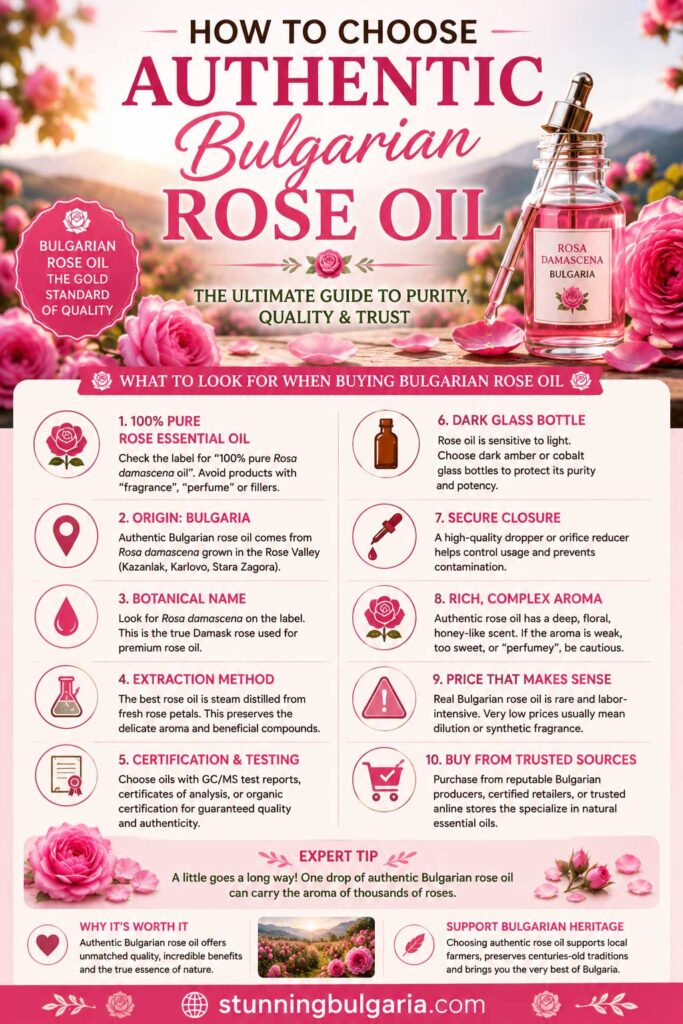
Because genuine Bulgarian rose oil is expensive to produce, shoppers can encounter products ranging from pure essential oil to heavily diluted blends and synthetic rose fragrances. A low price alone doesn’t necessarily mean a product is fake, but it may indicate that you’re looking at something other than pure rose essential oil.
Before buying, take a few minutes to read the label and understand exactly what you’re getting.
Look for the Botanical Name
Check the ingredient list for Rosa damascena.
For traditional Bulgarian rose essential oil, you may see wording such as Rosa damascena flower oil on the ingredient list.
A product that simply says “rose fragrance” or “rose-scented oil” isn’t necessarily the same thing as genuine rose essential oil.
Check the Country of Origin
If you’re specifically looking for Bulgarian rose oil, the producer or seller should clearly identify Bulgaria as the oil’s country of origin.
Some brands package or bottle rose oil in one country while sourcing the actual essential oil somewhere else, so look for information about where the roses were grown and distilled rather than relying only on the location of the company selling the bottle.
Understand Whether You’re Buying Pure or Diluted Rose Oil
Not every diluted product is bad.
Because pure rose essential oil is extremely concentrated and expensive, some reputable companies sell it pre-diluted in jojoba or another carrier oil. These products can be convenient for personal use and considerably less expensive.
The important thing is clear labeling.
If the product is diluted, the ingredient list should identify the carrier oil and ideally provide enough information for you to understand what you’re purchasing.
Be Suspicious of Extremely Cheap “Pure Rose Oil”
Authentic rose essential oil requires a huge quantity of flowers and considerable labor to produce.
If a large bottle advertised as “100% pure Bulgarian rose essential oil” costs about the same as an inexpensive everyday essential oil, take a closer look at the ingredients and seller information.
The product may be diluted, fragrance-based, or something entirely different from pure Rosa damascena essential oil.
Don’t Judge Authenticity by Scent Alone
Real rose oil has a rich and complex aroma, but fragrance isn’t a reliable authenticity test for most consumers.
Synthetic fragrances can smell convincingly floral, while genuine natural rose oil can vary somewhat depending on the harvest, storage, production method, and temperature.
The product’s origin, botanical name, ingredient transparency, producer information, and documentation are more useful clues.
Buy From a Transparent Producer or Seller
A trustworthy seller should make it relatively easy to determine:
- The botanical species
- The country of origin
- Whether the product is pure or diluted
- The extraction method
- The ingredients in any blend
- How the product should be stored and used
Established Bulgarian rose producers may also provide additional information about their growing areas, distillation process, testing, or product traceability.
Store Rose Oil Properly After Buying It
Once you’ve invested in quality rose oil, protect it from unnecessary exposure to heat, light, and air.
Keep the bottle tightly closed and follow the manufacturer’s storage instructions. Essential oils are commonly sold in dark glass bottles because light can affect aromatic compounds over time.
With such a concentrated and valuable product, proper storage helps you get the most from every drop.
For travelers, authentic rose products can also make a distinctive souvenir from Bulgaria—particularly when purchased from reputable producers and shops in the Rose Valley, Kazanlak, Karlovo, or other established rose-growing areas.
If you’re wondering what to look for beyond pure essential oil, explore our guide to the top products made with Bulgarian rose oil, including traditional beauty, skincare, and rose-based products from Bulgaria.
Frequently Asked Questions About Rose Oil
What Is Rose Oil Good For?
Rose oil is most commonly used in aromatherapy, perfumery, skincare, massage blends, and personal-care products. Its concentrated floral fragrance is one of its main attractions, while researchers have also investigated rose essential oil for potential antimicrobial, antioxidant, and relaxation-related properties.
It should be considered a cosmetic or complementary wellness product rather than a treatment for medical conditions.
What Are the Main Benefits of Rose Oil?
The potential benefits of rose oil include its use in relaxing aromatherapy, skincare products, massage blends, natural fragrance, and personal-care routines. Laboratory research has also explored antioxidant and antimicrobial properties associated with rose-derived compounds.
The strength of scientific evidence varies considerably depending on the claimed benefit.
Can You Put Rose Oil Directly on Your Skin?
Pure rose essential oil is highly concentrated, so it is generally better to dilute it appropriately before applying it to the skin.
You can also choose a professionally formulated facial oil, serum, moisturizer, or other cosmetic product that already contains rose oil at an appropriate concentration.
Is Rose Oil Good for Your Face?
Rose essential oil is used in many facial skincare products, particularly formulas intended for dry, mature-looking, or blemish-prone skin.
If you want to use rose oil on your face, choose a properly formulated product or dilute the essential oil carefully in a suitable carrier oil. Patch-testing a new product first is also sensible.
Can Rose Oil Help With Acne?
Rose essential oil and rose-derived compounds have been studied for properties that may be interesting in skincare, including antimicrobial and antioxidant activity.
However, rose oil shouldn’t be considered an acne treatment, and applying undiluted essential oil directly to blemishes may irritate the skin. Persistent or severe acne is better discussed with a dermatologist or another qualified healthcare professional.
Does Rose Oil Help With Anxiety?
Some research has investigated rose aromatherapy in relation to relaxation, stress, and anxiety, with some promising findings.
The evidence isn’t strong enough to consider rose essential oil a treatment for an anxiety disorder. Its aroma can instead be incorporated into a broader relaxation routine alongside activities such as meditation, massage, or a warm bath.
What Does Bulgarian Rose Oil Smell Like?
Authentic Bulgarian Rosa damascena oil has an intense and complex floral fragrance. Depending on the oil, you may notice sweet, warm, fresh, slightly spicy, honey-like, or green notes rather than a simple artificial “rose” scent.
Because it is highly concentrated, even a small amount can have a powerful aroma.
Why Is Bulgarian Rose Oil So Expensive?
Pure Bulgarian rose oil is expensive because producing it requires an enormous quantity of freshly harvested rose blossoms.
The flowers are traditionally picked by hand during a relatively short flowering season and need to be processed quickly. Only a small amount of essential oil is obtained from all that plant material, contributing to its high value.
What Is the Difference Between Rose Oil and Rosehip Oil?
Rose essential oil comes primarily from rose petals and is valued for its highly concentrated fragrance.
Rosehip oil comes from the fruits and seeds of roses and is a fatty plant oil commonly used in skincare. Rosehip oil doesn’t normally have the powerful floral aroma associated with rose essential oil.
Is Rose Oil the Same as Rose Water?
No. Rose essential oil is a highly concentrated aromatic oil, while rose water is an aromatic water associated with rose distillation and is much less concentrated.
Both can come from Rosa damascena, but they have different compositions, strengths, and uses.
Can You Eat Rose Oil?
Don’t assume rose essential oil is suitable for consumption. Essential oils are extremely concentrated, and products vary in composition and intended use.
For cooking, desserts, and drinks, choose a rose water or rose product specifically manufactured and labeled for culinary use rather than using a cosmetic or aromatherapy essential oil.
Where Does Bulgarian Rose Oil Come From?
The best-known rose-growing region in Bulgaria is the Rose Valley, particularly the areas around Kazanlak and Karlovo in central Bulgaria.
The region has a long tradition of cultivating Rosa damascena and producing rose oil, rose water, cosmetics, and other rose-based products.
When Are Roses Harvested in Bulgaria?
The Bulgarian rose harvest generally takes place during late spring and early summer, although exact timing varies according to weather and location.
Flowers are traditionally picked early in the morning and transported for processing soon afterward.
Can You Visit Bulgaria During the Rose Harvest?
Yes. Rose season is one of the most interesting times to visit central Bulgaria.
Visitors can experience rose-related events, visit rose producers and museums, see blooming fields, and attend celebrations associated with the Rose Festival in Kazanlak. If experiencing the harvest is your priority, check the year’s flowering conditions and festival dates before planning your trip.
Why Bulgarian Rose Oil Is Worth Discovering
The benefits of rose oil help explain why this intensely fragrant essential oil has remained valuable for generations. From aromatherapy and massage blends to skincare, perfumery, and personal-care products, only a small amount is needed to enjoy its distinctive floral aroma.
At the same time, it’s important to separate traditional uses from claims supported by stronger scientific evidence. Rose essential oil shouldn’t be viewed as a cure for medical conditions, and because it is highly concentrated, it should be used carefully and diluted appropriately for topical applications.
For Bulgaria, however, rose oil represents much more than another essential oil.
The fields of Rosa damascena in the Rose Valley, early-morning flower picking, traditional distillation, and generations of rose growers have made Bulgarian rose oil part of the country’s cultural identity.
If you visit Bulgaria during rose season, experiencing the Rose Valley in bloom is one of the best ways to understand why this tiny bottle of fragrant oil has become one of Bulgaria’s most famous natural products.
Have You Tried Bulgarian Rose Oil?
Have you used Bulgarian rose oil for skincare, aromatherapy, massage, or simply because you love its fragrance? We’d love to hear about your experience.
Share your favorite ways to use rose oil in the comments below, or tag @stunningbulgaria on Instagram and use #stunningbulgaria when sharing your Bulgarian rose discoveries.
Discover More of Bulgaria’s Rose Traditions
Bulgarian rose oil is only one part of the story. If you’re curious about where the roses grow, how the oil is made, or what it’s like to visit during rose season, these guides will take you deeper into Bulgaria’s centuries-old rose tradition:
- Bulgaria’s Rose Valley – See where the famous Damask roses grow and why this part of central Bulgaria became the heart of the country’s rose industry.
- Rose Festival in Kazanlak – Planning to visit during rose season? Here’s what happens during the festival and what you can expect in Kazanlak.
- How Bulgarian Rose Oil Is Made – Go behind the scenes, from roses picked early in the morning to the traditional distillation process.
- Why Bulgarian Rose Oil Is So Expensive – A tiny bottle takes an incredible number of rose blossoms to produce. Here’s why.
- Visiting Bulgaria During Rose Season – Find out when the roses bloom, where to see the fields, and which rose-related experiences are worth adding to your trip.