Some of the most fascinating facts about Rila Monastery reveal a story that stretches back more than 1,000 years. Surrounded by the forested peaks of the Rila Mountains, its striped arches, stone walls, colorful frescoes, and dramatic mountain setting make it one of Bulgaria’s most recognizable landmarks.
But behind its beautiful architecture lies a story stretching back more than 1,000 years.
The Monastery of Saint Ivan of Rila has survived destruction, fires, rebuilding, and centuries of political change. Through some of the most difficult periods in Bulgarian history, it remained an important spiritual and cultural center, helping preserve Bulgarian religious traditions, art, literature, and education.
Its story begins with Saint Ivan of Rila, a 10th-century hermit who left ordinary life behind and sought solitude in the Rila Mountains. His followers eventually established a monastic community nearby, beginning the long history of what would become Bulgaria’s largest and most celebrated Orthodox monastery.
Today, Rila Monastery is a UNESCO World Heritage Site and one of the most visited cultural landmarks in Bulgaria. Thousands of visitors come to admire its fresco-covered church, peaceful courtyard, medieval tower, museum treasures, and spectacular mountain surroundings.
The Rila Monastery is one of Bulgaria’s most famous UNESCO World Heritage sites.
Yet many of its most fascinating stories are easy to miss during a visit.
Why did one monk spend years carving hundreds of miniature figures into a wooden cross? Which part of the monastery survived a devastating 19th-century fire? And how did this remote mountain sanctuary become such an important symbol of Bulgarian identity?
Here are 20 fascinating facts about Rila Monastery that reveal the history, people, art, and hidden details behind one of Bulgaria’s greatest treasures.
Rila Monastery Quick Facts
| Quick Fact | Details |
|---|---|
| Official name | Monastery of Saint Ivan of Rila |
| Bulgarian name | Рилски манастир „Свети Иван Рилски“ |
| Location | Rila Mountains, southwestern Bulgaria |
| Founded | 10th century |
| Founder | Saint Ivan of Rila and the monastic community associated with his followers |
| Religion | Eastern Orthodox Christianity |
| Main church | Church of the Nativity of the Virgin |
| Oldest surviving building | Hrelyo’s Tower, 1334–1335 |
| UNESCO status | World Heritage Site since 1983 |
| Elevation | Approximately 1,150 m (3,770 ft) |
| Distance from Sofia | Approximately 120 km (75 miles) by road |
| Recommended visit | 2–3 hours |
| Best for | History, architecture, religious art, culture, photography, mountain scenery |
20 Fascinating Facts About Rila Monastery

Rila Monastery is much more than a beautiful place to photograph. Behind its famous arches and fresco-covered walls are more than a thousand years of Bulgarian history, along with remarkable stories of monks, artists, fires, rebuilding, and cultural survival.
Here are some of the most interesting facts about Rila Monastery and the people who shaped its extraordinary history.
Also Read: Why You Should Visit Seven Rilla Lakes in Bulgaria
1. Rila Monastery Was Founded in the 10th Century
The origins of Rila Monastery date back to the 10th century, during the reign of Bulgarian Tsar Peter I. Its history is closely connected with Saint Ivan of Rila, also known as Saint John of Rila, one of the most revered saints in Bulgaria.
Saint Ivan did not begin by constructing the enormous monastery complex visitors see today. Seeking a life of prayer and solitude, he withdrew into the Rila Mountains and lived as a hermit in the wilderness.
Over time, his reputation for holiness attracted followers who came to the mountains to learn from him. A monastic community gradually developed, laying the foundations for the monastery that would eventually bear his name.
The buildings standing today are the result of centuries of construction, destruction, and rebuilding, so the monastery looks very different from the small religious community that existed here more than 1,000 years ago.
2. Saint Ivan of Rila Lived as a Hermit in the Mountains
The story of Rila Monastery begins with a man who wanted very little from the material world.
Saint Ivan of Rila was born in the late 9th century and eventually withdrew into the mountains to live as a hermit. According to tradition, he spent part of his solitary life in a cave in the Rila Mountains, dedicating himself to prayer, fasting, and a simple existence away from society.
His reputation gradually spread, and people began traveling into the mountains seeking his guidance. Some became his followers, helping establish the monastic community that eventually developed into Rila Monastery.
Saint Ivan died in 946, but his influence continued to grow. He became the patron saint of Bulgaria and remains one of the most important figures in the Bulgarian Orthodox tradition.
His relics traveled far beyond Rila during the centuries that followed. After being kept in several locations, including Tarnovo, they were ceremonially returned to Rila Monastery in 1469.
Visitors can still connect with the monastery’s earliest history by following the mountain route to the Cave of Saint Ivan of Rila, located a few kilometers from the main monastery complex.
3. Hrelyo’s Tower Is the Oldest Surviving Building in Rila Monastery
Among the colorful arches and frescoes of Rila Monastery stands a much older structure that is easy to overlook: Hrelyo’s Tower.
The stone defensive tower was built in 1334–1335 by the feudal lord Hrelyo Dragolov, during a major period of rebuilding at the monastery. Rising approximately 23 meters (75 feet), it was designed to provide protection during dangerous times.
Its thick stone walls and narrow openings give it the appearance of a small medieval fortress rather than part of a monastery.
What makes Hrelyo’s Tower particularly remarkable is its survival. Much of the monastery was destroyed or rebuilt over the centuries, including after the devastating fire of 1833, but the medieval tower remained standing.
On the tower’s upper floor is a small chapel dedicated to the Transfiguration of Christ, containing surviving medieval frescoes.
More than 690 years later, Hrelyo’s Tower still stands in the monastery courtyard, surrounded by buildings constructed centuries after it.
4. A Devastating Fire Destroyed Much of Rila Monastery in 1833
The impressive monastery complex visitors see today exists partly because of a disaster that nearly destroyed it.
On January 13, 1833, a major fire swept through Rila Monastery, severely damaging much of the complex. Residential quarters, wooden structures, and other parts of the monastery were destroyed, creating an enormous rebuilding challenge.
Instead of abandoning the centuries-old spiritual center, Bulgarians from different parts of the country supported its reconstruction with donations and skilled labor. The rebuilding effort became an important expression of the growing cultural confidence of the Bulgarian National Revival.
Master builder Alexi Rilets played a major role in shaping the monastery complex during this period. Under his direction, damaged sections were reconstructed while preserving the distinctive enclosed form of the monastery.
The rebuilding continued over the following years rather than being completed in the often-repeated but inaccurate claim of only a few days.
One remarkable structure survived the disaster: the medieval Hrelyo’s Tower. Its survival provides a striking contrast between the monastery’s medieval past and the predominantly 19th-century architecture surrounding it today.
5. Master Builder Alexi Rilets Helped Shape the Monastery We See Today
One of the most important names connected with the architecture of Rila Monastery is Alexi Rilets, a Bulgarian master builder who played a major role in the monastery’s reconstruction during the 19th century.
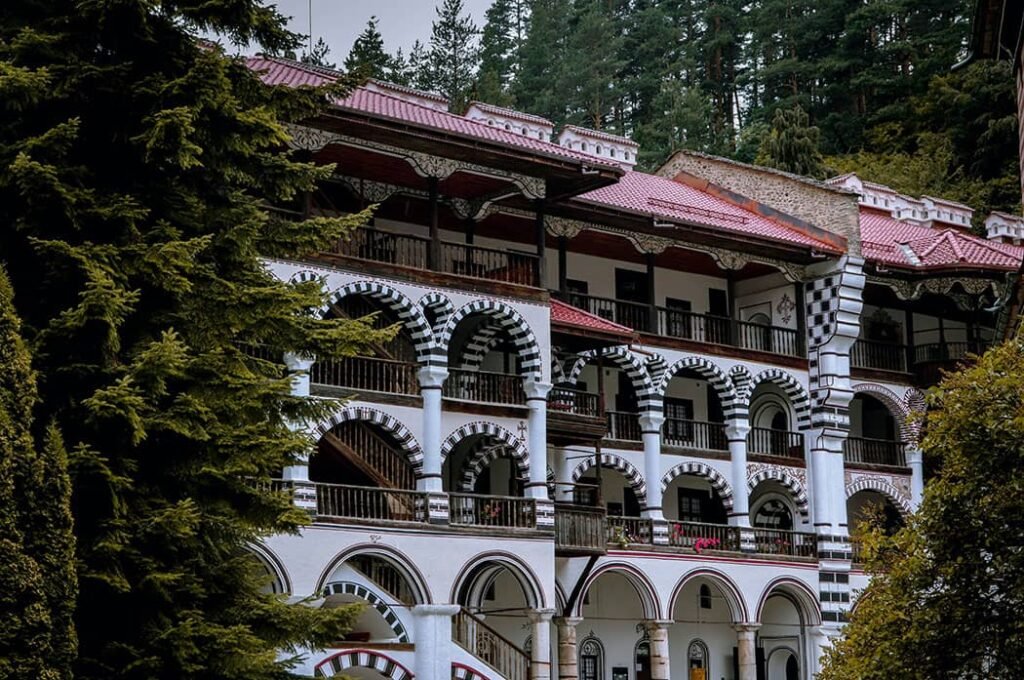
Alexi Rilets worked on significant parts of the residential complex, helping create the distinctive appearance that visitors recognize today. The monastery’s multi-level galleries, stone staircases, arches, wooden balconies, and enclosed courtyard combine the practical needs of monastic life with the architectural traditions of the Bulgarian National Revival.
His work became especially important after the devastating 1833 fire, when large sections of the monastery had to be rebuilt.
One fascinating detail survives in the monastery itself. Inscriptions associated with Alexi Rilets can be found above several entrances, leaving a physical record of the master builder responsible for much of the complex.
Look beyond the main church when you’re in the courtyard—the surrounding galleries, staircases, balconies, and residential wings are a major part of Alexi Rilets’ architectural legacy.
6. The Main Church Was Built in the 19th Century
Although Rila Monastery traces its origins back more than 1,000 years, its magnificent main church is much younger.
The Church of the Nativity of the Virgin, standing in the center of the monastery courtyard, was built between 1835 and 1837 by master builder Pavel Ioanov. Its domes, arches, striped exterior, and surrounding galleries make it the architectural centerpiece of the monastery.
The church is even more impressive when you step beneath its covered galleries. Its walls and ceilings are covered with elaborate frescoes depicting biblical scenes, saints, angels, and dramatic visions of heaven and judgment.
Some of the finest Bulgarian artists of the National Revival period contributed to the decoration of the church, including Zahari Zograf, one of Bulgaria’s most celebrated 19th-century painters. Artists from the Samokov and Bansko schools also worked on its extensive frescoes.
Inside is another masterpiece: the enormous gilded iconostasis. Its intricate woodcarving is filled with religious figures, plants, animals, and decorative details, demonstrating the extraordinary craftsmanship of Bulgarian woodcarvers of the period.
The contrast between the relatively austere medieval Hrelyo’s Tower nearby and the richly decorated 19th-century church makes the central courtyard one of the best places to see different periods of Rila Monastery’s history side by side.
7. Rila Monastery Helped Preserve Bulgarian Culture During Ottoman Rule
For centuries, Rila Monastery was more than a place of worship. It also became an important center of Bulgarian education, literature, art, and cultural identity.
During the centuries of Ottoman rule, monks at the monastery copied and preserved religious texts, maintained a valuable library, and helped keep Bulgarian literary and artistic traditions alive. The monastery also maintained connections with other Orthodox centers beyond Bulgaria, helping books, ideas, and religious works circulate across the region.
Its cultural importance became especially visible during the Bulgarian National Revival, when monasteries played an important role in education and the growing interest in Bulgarian language, history, and identity.
One of the figures closely associated with Rila Monastery was Neofit Rilski, a monk, teacher, and scholar who became an influential Bulgarian educator. He taught at the monastery and later became one of the leading intellectual figures of the National Revival.
The monastery’s contribution to Bulgarian culture is one of the reasons UNESCO considers Rila Monastery an important symbol of Slavic cultural identity following centuries of occupation.
8. The Monastery Library Preserves Centuries-Old Manuscripts and Books
One of the lesser-seen treasures of Rila Monastery is its remarkable collection of manuscripts, early printed books, and historical documents.
For centuries, monks copied, collected, studied, and preserved religious and literary works, turning the monastery into an important center of learning as well as worship. Some manuscripts in its collection date back hundreds of years and provide valuable evidence of Bulgaria’s medieval and National Revival literary traditions.
The monastery library preserves hundreds of manuscripts and thousands of old printed books, including religious texts and works written in several languages.
These collections are especially significant because Rila Monastery passed through periods of invasion, destruction, fire, and reconstruction. The survival of so much written material gives historians and researchers an important window into the religious, intellectual, and cultural life of earlier centuries.
Some of those manuscripts and early printed works have survived centuries of upheaval, making the library one of the monastery’s most valuable historical collections.
9. Rila Monastery Became a UNESCO World Heritage Site in 1983
One of the most important facts about Rila Monastery is its international recognition. In 1983, the monastery was inscribed on the UNESCO World Heritage List, confirming its exceptional cultural and historical importance.
UNESCO recognizes Rila Monastery not only for its striking architecture, but also for the role it has played in the spiritual and cultural history of Bulgaria for centuries.
The monastery’s surviving medieval elements, 19th-century National Revival architecture, religious art, frescoes, and remarkable mountain setting all contribute to its significance.
Its history also tells a much larger story. Despite periods of destruction and foreign rule, Rila Monastery remained an important center of Orthodox Christianity and Bulgarian cultural identity.
Today, it is one of Bulgaria’s best-known UNESCO World Heritage Sites and one of the country’s most recognizable landmarks.
10. Rila Monastery Appeared on Bulgaria’s 1 Lev Banknote
Rila Monastery became so closely associated with Bulgaria’s national heritage that it even appeared on the country’s currency.
The reverse of the 1 lev banknote issued in 1999 featured an image of Rila Monastery, while the front portrayed Saint Ivan of Rila, the monastery’s founder and one of the most revered Bulgarian Orthodox saints.
The choice was particularly fitting. Rather than simply featuring a famous tourist attraction, the banknote brought together the monastery and the man whose spiritual legacy inspired its creation more than a thousand years ago.
The 1 lev banknote did not remain in everyday circulation for long. It was later replaced by the 1 lev coin, making the banknote an interesting piece of modern Bulgarian history and a collectible reminder of Rila Monastery’s cultural importance.
11. Rafail’s Cross Contains Hundreds of Tiny Hand-Carved Figures
One of the most extraordinary treasures at Rila Monastery is Rafail’s Cross, a miniature woodcarving that rewards a much closer look.
The cross was created by a monk named Rafail, who spent years carving incredibly detailed religious scenes into a single piece of wood. Using tiny chisels, knives, and magnifying lenses, he transformed the cross into an intricate collection of biblical scenes and miniature human figures.
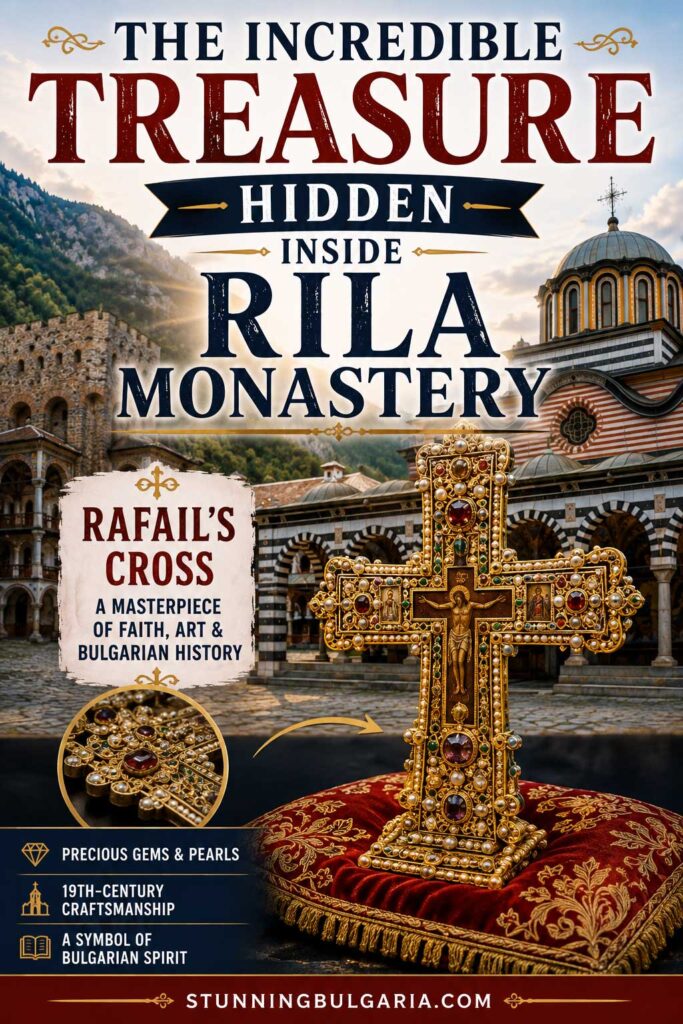
Completed in 1802, the cross contains 104 religious scenes and around 650 miniature figures.
What makes the story even more remarkable is the scale of the work. Many of the figures are extremely small, yet they contain individual details that required extraordinary precision and patience to carve by hand.
According to the traditional account associated with the cross, the years of intense close work severely damaged Rafail’s eyesight, and he eventually lost his sight.
Today, Rafail’s Cross is preserved in the Rila Monastery Museum. Look closely when you see it—the amount of detail packed into such a small piece of wood is astonishing.
12. The Rila Monastery Museum Holds Treasures From Centuries of History
Rila Monastery has its own museum, and it is easy to underestimate just how much history is preserved inside.
The monastery’s collections include religious icons, manuscripts, early printed books, church objects, textiles, woodcarvings, historical documents, and other artifacts connected with centuries of monastic life.
Many of these objects help tell a story that cannot be understood simply by walking around the courtyard. They reveal how the monastery functioned as a religious, artistic, educational, and cultural center through different periods of Bulgarian history.
The museum’s most famous treasure is undoubtedly Rafail’s Cross, but it is far from the only reason to visit. The collection provides a closer look at the craftsmanship and religious art that developed around the monastery over the centuries.
13. Rila Monastery Is the Largest Monastery in Bulgaria
Rila Monastery is not only Bulgaria’s most famous monastery—it is also the largest monastic complex in the country.
The monastery covers approximately 8,800 square meters (about 2.2 acres) and is built around a large central courtyard. From outside, its high stone walls and relatively austere exterior give it an almost fortress-like appearance. Passing through the gates reveals something completely different: multiple levels of graceful arches, wooden balconies, staircases, and the richly decorated main church.
The residential sections contain hundreds of monastic cells and rooms, along with chapels, service areas, historic kitchens, storage spaces, and rooms that once supported the monastery’s large religious community and its visitors.
One of the most fascinating spaces is the monastery’s historic kitchen, known as the magernitsa. Its enormous chimney rises through several levels and was ingeniously designed to carry smoke from the large cooking fires upward and out of the building.
The sheer scale of the complex can be difficult to appreciate in photographs. Once inside the courtyard, the surrounding multi-story residential wings make it clear why Rila Monastery feels almost like a small fortified settlement hidden in the mountains.
_-_fresco_2.JPG "20 Facts About Rila Monastery You Didn't Know 4")
14. Rila Monastery Sits More Than 1,100 Meters Above Sea Level
Part of what makes Rila Monastery so memorable is its location. Rather than standing in a major city or town, the monastery is hidden deep within the Rila Mountains of southwestern Bulgaria.
The complex sits at an elevation of roughly 1,150 meters (3,770 feet) above sea level, surrounded by forested mountain slopes in the valley of the Rilska River.
This remote setting is closely connected to the monastery’s origins. Saint Ivan of Rila came to these mountains seeking solitude and a life devoted to prayer, far from the settlements below. More than a thousand years later, the landscape remains an essential part of the experience of visiting the monastery.
The surrounding territory is protected within Rila Monastery Nature Park, an area of forests, mountain rivers, peaks, and hiking trails.
Visitors who have enough time can explore beyond the main complex and follow the route toward the Cave of Saint Ivan of Rila, traditionally associated with the saint’s years as a hermit.
By the time the road reaches the monastery, Sofia feels a long way away. Forested slopes rise around the complex, and the Rilska River runs through the narrow mountain valley below.
15. Rila Monastery Received the Golden Apple Award for Cultural Tourism
Rila Monastery’s importance has been recognized not only by UNESCO but also by the international travel community.
In 1980, the monastery received the Golden Apple, an award presented by the International Federation of Travel Journalists and Writers (FIJET) to recognize destinations, organizations, and individuals for exceptional contributions to tourism.
Sometimes described as the “Oscar of tourism,” the Golden Apple has been awarded to culturally and historically significant destinations around the world.
For Rila Monastery, the recognition came several years before its inscription on the UNESCO World Heritage List in 1983, reflecting the monastery’s already established international reputation as one of Bulgaria’s great cultural treasures.
More than four decades later, the reasons for that recognition are clear. Few places in Bulgaria combine medieval history, Orthodox spirituality, National Revival architecture, extraordinary religious art, and dramatic mountain scenery in one location.
16. The Monastery Has an Extraordinary 19th-Century Kitchen
One of the most unusual places inside Rila Monastery is not a chapel or a museum room, but its enormous historic kitchen.
Known as the magernitsa, the monastery kitchen was designed to prepare food for the large monastic community as well as the pilgrims and guests who arrived at Rila over the centuries.
Its most striking feature is the huge funnel-shaped chimney rising high above the cooking area. Built from stone and brick, the chimney narrows as it climbs through the upper levels of the monastery, creating an ingenious ventilation system that carried smoke from the cooking fires out through the roof.
Several large hearths allowed substantial quantities of food to be prepared at the same time. Large metal cauldrons and cooking vessels provide an idea of the number of people the monastery could once accommodate.
The kitchen is a fascinating reminder that Rila Monastery was essentially a self-contained community. Behind its famous frescoes and churches was an entire system needed to feed, house, and support monks, pilgrims, workers, and visitors in an isolated mountain location.
Look up when you enter the magernitsa. Its towering chimney is the feature that makes this otherwise practical space so memorable.
17. Saint Ivan of Rila’s Relics Returned to the Monastery in 1469
Although Saint Ivan of Rila spent much of his life in the Rila Mountains, his relics did not remain at the monastery continuously after his death in 946.
Over the following centuries, they were moved several times as Bulgaria experienced wars and political upheaval. The relics were eventually taken to Tarnovo, the medieval capital of the Second Bulgarian Empire, where they remained for centuries.
Then, in 1469, one of the most important events in the history of Rila Monastery took place.
The saint’s relics were ceremonially returned from Tarnovo to the monastery. Their journey through Bulgarian lands became an important religious event, and an account of the transfer was written by Vladislav the Grammarian, one of the notable Bulgarian literary figures of the 15th century.
The return had significance beyond religion. Coming during the early centuries of Ottoman rule, it helped restore Rila Monastery’s position as an important spiritual and cultural center.
The relics remain at Rila Monastery, more than five centuries after their return from Tarnovo.
18. Rila Monastery Is One of Bulgaria’s Most Famous Tourist Attractions
Rila Monastery is not only an important religious site—it is also one of the best-known tourist attractions in Bulgaria.
Visitors travel into the Rila Mountains to see the monastery’s extraordinary combination of history, Orthodox art, National Revival architecture, and mountain scenery. Its location within easy reach of Sofia also makes it one of the most popular cultural day trips from the Bulgarian capital.
International recognition has helped make the monastery famous far beyond Bulgaria. Its inclusion on the UNESCO World Heritage List, together with its distinctive striped arches and colorful frescoes, has made Rila Monastery one of the country’s most recognizable landmarks.
The monastery has attracted very large numbers of visitors over the years. Historical tourism reports have cited particularly high attendance during peak periods, demonstrating how important the site has become to Bulgaria’s tourism industry.
Yet Rila Monastery remains an active Bulgarian Orthodox monastery, not simply a tourist attraction. Visitors are entering a functioning religious site where worship and monastic traditions continue alongside tourism.
19. Rila Monastery Was Designed With a Fortress-Like Appearance
From the outside, Rila Monastery can look surprisingly different from the colorful images most visitors have seen before arriving.
The complex is enclosed by massive stone walls and forms an irregular quadrangle, giving the monastery the appearance of a mountain fortress. Small exterior windows and imposing entrance gates add to this defensive character.
Step through the gates, however, and the atmosphere changes completely.
Inside is a spacious courtyard surrounded by several stories of elegant arches, columns, wooden balconies, staircases, and residential galleries. At its center stand the richly decorated Church of the Nativity of the Virgin and the medieval Hrelyo’s Tower.
This dramatic contrast between the austere exterior and colorful interior is one of the most memorable architectural features of Rila Monastery.
The enclosed design also had a practical purpose. Throughout its long history, the monastery needed to protect its religious community, valuable manuscripts, icons, supplies, and visitors in what was once a remote and sometimes dangerous mountain environment.
Today, walking through the heavy monastery gates and seeing the magnificent courtyard suddenly appear in front of you remains one of the most impressive moments of a visit to Rila Monastery.
20. You Can Visit the Cave Where Saint Ivan of Rila Lived as a Hermit
One of the most meaningful places connected with Rila Monastery is actually located beyond the monastery walls.
A few kilometers into the mountains is the Cave of Saint Ivan of Rila, traditionally associated with the years the saint spent living as a hermit. The site offers visitors a glimpse into the simple and isolated life that gave rise to one of Bulgaria’s greatest religious centers.
Reaching the cave requires a short walk through the forest from the area near the Church of the Dormition of Saint Ivan of Rila. The peaceful mountain setting feels very different from the busy courtyard of the main monastery and helps explain why Saint Ivan chose the Rila Mountains for a life of solitude and prayer.
The cave itself is small and remarkably modest, especially when compared with the enormous monastery that eventually developed from the community inspired by the saint.
A local tradition adds another memorable detail. Visitors can pass through a narrow opening in the rocks above the cave, although the passage is tight and is best avoided by anyone uncomfortable with confined spaces or uneven climbing.
Whether or not you attempt the passage, visiting Saint Ivan’s cave provides a fitting conclusion to the story of Rila Monastery. The grand churches, frescoes, museum treasures, and residential buildings all trace their history back to a hermit who sought solitude in these mountains more than a thousand years ago.
The History of Rila Monastery
The history of Rila Monastery stretches across more than a thousand years and mirrors many of the most important periods in Bulgarian history.
Its origins date to the 10th century and the spiritual community that developed around Saint Ivan of Rila. After withdrawing into the Rila Mountains as a hermit, the saint attracted followers who continued his religious traditions and established a monastic community in the area.
From a Hermit’s Retreat to a Medieval Monastery
Rila Monastery grew considerably during the medieval period. By the 14th century, it had become an important religious and cultural center.
One of the most important surviving structures from this era is Hrelyo’s Tower, built in 1334–1335. It remains the oldest surviving building within the monastery complex and provides a rare physical connection to medieval Rila.
Destruction and Revival
The Ottoman conquest brought a difficult period for the monastery. Rila suffered destruction and decline, but monastic life was eventually restored.
A particularly important moment came in 1469, when the relics of Saint Ivan of Rila were ceremonially returned from Tarnovo to the monastery. The event strengthened Rila’s position as an important spiritual destination and place of pilgrimage.
Over the following centuries, the monastery maintained relationships with Orthodox communities elsewhere in the Balkans and beyond while continuing to preserve religious manuscripts, books, art, and traditions.
The Bulgarian National Revival
Rila Monastery flourished again during the Bulgarian National Revival, becoming an important center of religion, education, art, and Bulgarian cultural identity.
Disaster struck in 1833, when a major fire destroyed large portions of the complex. Instead of marking the end of Rila Monastery, the fire triggered an ambitious reconstruction.
Much of the architecture visitors see today dates from this period. The Church of the Nativity of the Virgin was constructed between 1835 and 1837, while artists and craftsmen created the elaborate frescoes, woodcarvings, and architectural details that give the monastery its distinctive appearance.
Rila Monastery Today
Rila Monastery survived the political transformations of the 20th century and remains an active center of the Bulgarian Orthodox Church.
In 1983, it was inscribed on the UNESCO World Heritage List in recognition of its exceptional cultural significance.
Today, pilgrims, travelers, historians, and photographers come from around the world to experience a place where medieval history, Bulgarian National Revival art, Orthodox Christianity, and the landscape of the Rila Mountains meet within a single extraordinary complex.
Rila Monastery Architecture and What to Look For
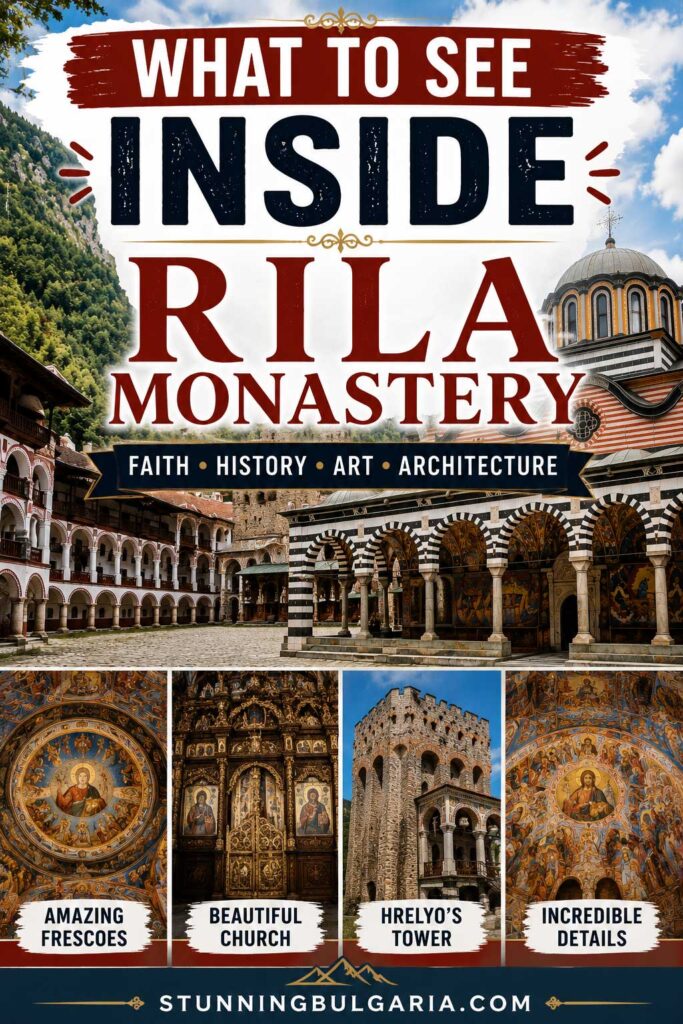
The architecture of Rila Monastery is one of the main reasons the complex is so unforgettable. From outside, its high stone walls give it the appearance of a fortress. Once you pass through the gates, however, the interior opens into a colorful courtyard filled with arches, balconies, frescoes, and domes.
Much of what visitors see today dates from the Bulgarian National Revival, although important medieval elements have survived.
Church of the Nativity of the Virgin
Standing in the center of the courtyard, the Church of the Nativity of the Virgin is the architectural and spiritual heart of Rila Monastery.
Built between 1835 and 1837, the church immediately stands out for its domes, striped arches, and covered galleries. The exterior walls beneath the arches are covered with remarkably detailed frescoes depicting biblical stories, saints, angels, demons, and scenes of judgment.
Don’t walk past them too quickly. Some of the most fascinating details at Rila Monastery are hidden within these large compositions.
Inside the church, look for the magnificent gilded iconostasis, one of the great examples of Bulgarian National Revival woodcarving.
Hrelyo’s Tower
Beside the church stands Hrelyo’s Tower, the oldest surviving structure in the monastery.
Built in 1334–1335, the stone tower looks noticeably different from the colorful 19th-century buildings surrounding it. Its heavy walls and defensive appearance offer a glimpse of the medieval monastery that existed here centuries before the present complex was constructed.
A small chapel dedicated to the Transfiguration of Christ occupies the upper part of the tower and contains surviving medieval frescoes.
The Residential Galleries
Look upward when standing in the courtyard.
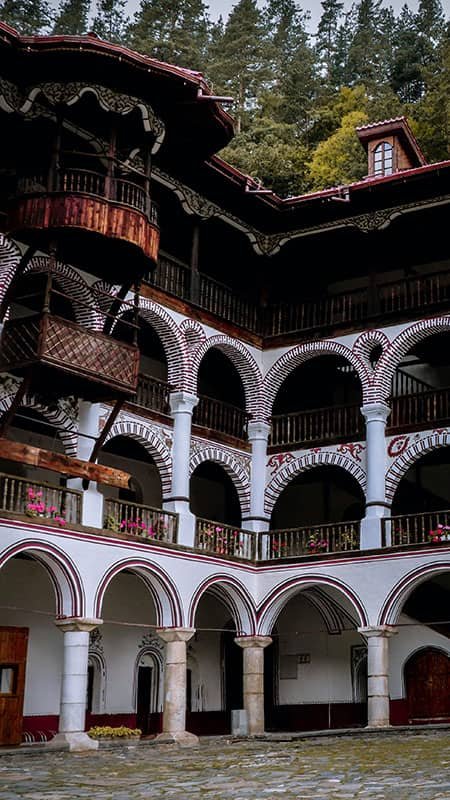
The surrounding residential wings rise several stories and are lined with elegant arches, columns, wooden balconies, and exterior staircases. Together, they create the distinctive enclosed appearance that makes Rila Monastery instantly recognizable.
These weren’t simply decorative spaces. Behind the galleries were monastic cells, guest rooms, storage areas, chapels, and other rooms necessary for everyday life in a large mountain monastery.
The Historic Monastery Kitchen
Another architectural highlight is the historic magernitsa, or monastery kitchen.
Its most remarkable feature is the enormous chimney structure rising through the building. The unusual design allowed smoke from large cooking fires to escape while meals were prepared for monks, pilgrims, workers, and guests.
It is easy to overlook compared with the church and frescoes, but the kitchen is one of the best places to understand how this remote monastic community functioned in everyday life.
Look Beyond the Famous Courtyard View
The classic photograph of Rila Monastery captures the church, Hrelyo’s Tower, and surrounding galleries, but don’t experience the monastery only through your camera.
Walk around the entire courtyard, look beneath the painted arches, study the woodwork and stonework, and pay attention to the contrast between the medieval and National Revival architecture.
Those smaller details are what make Rila Monastery much more interesting than a quick photo stop.
Inside Rila Monastery: Don’t Miss These Highlights
If you have only a couple of hours at Rila Monastery, focus on a handful of highlights rather than trying to see every corner of the complex.
Church of the Nativity of the Virgin
Start with the Church of the Nativity of the Virgin. Walk around the covered exterior galleries first, where you can get a close look at the colorful frescoes, then step inside to see the gilded iconostasis and religious icons.
Remember that this is an active place of worship, so keep your voice low and follow any posted photography restrictions.
Hrelyo’s Tower
Standing beside the church, Hrelyo’s Tower is the oldest surviving building at Rila Monastery and one of the best places to appreciate its medieval past.
If the tower is open during your visit, check whether you can see the interior and the small chapel above.
Rila Monastery Museum
Don’t skip the Rila Monastery Museum if you have time. Its most famous treasure is Rafail’s Cross, carved with 104 religious scenes and hundreds of tiny figures.
You’ll also find icons, manuscripts, historical documents, religious objects, and other artifacts connected with the monastery’s long history.
The Historic Magernitsa
The monastery’s enormous historic kitchen, known as the magernitsa, is easy to overlook but well worth seeing.
Its huge chimney and cooking spaces offer a glimpse into everyday life at Rila when the monastery had to feed monks, pilgrims, workers, and guests in this remote mountain setting.
The Courtyard and Galleries
Don’t leave as soon as you’ve photographed the church.
Walk around the courtyard and residential galleries, look up at the wooden balconies and staircases, and view the church and Hrelyo’s Tower from different sides. Some of the monastery’s best architectural details are easy to miss if you stay only around the main entrance.
If You Have More Time
If you have a few extra hours, continue beyond the monastery to the Cave of Saint Ivan of Rila.
The quiet forest setting and modest cave provide a striking contrast to the enormous monastery complex and bring you much closer to the place where the story of Rila Monastery began.
Where Is Rila Monastery?
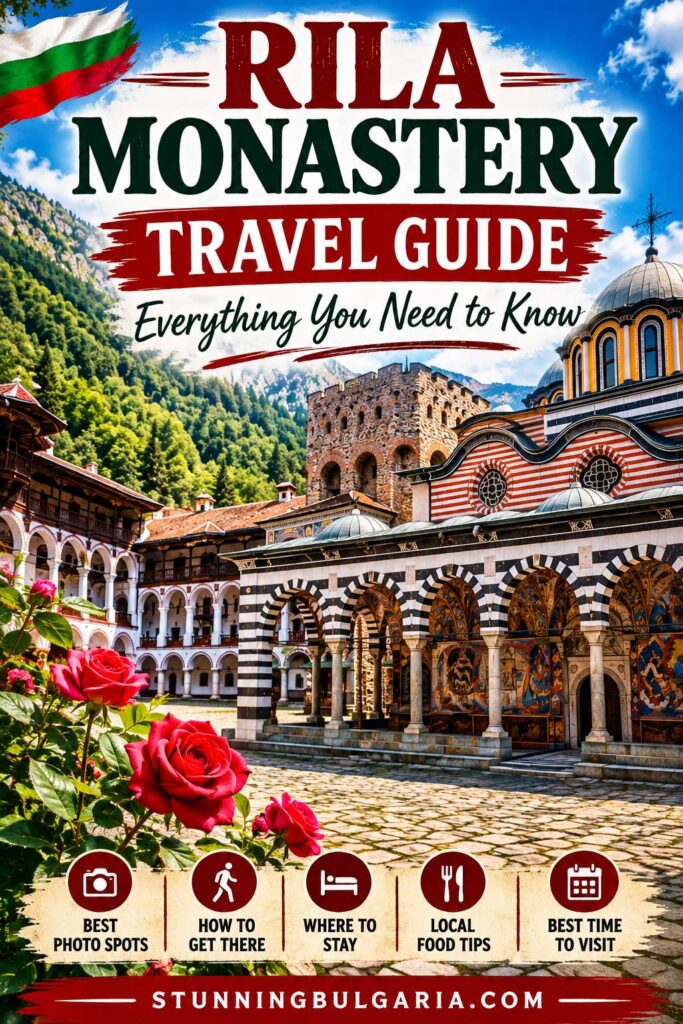
Rila Monastery is located deep in the Rila Mountains of southwestern Bulgaria, approximately 120 km (75 miles) south of Sofia by road. Despite its name, the monastery is not located directly in the town of Rila—it lies farther into the mountains, surrounded by forests in the valley of the Rilska River.
The monastery sits at an elevation of roughly 1,150 meters (3,770 feet) above sea level within Rila Monastery Nature Park, giving it one of the most spectacular settings of any historic landmark in Bulgaria.
How Far Is Rila Monastery From Sofia?
The drive from Sofia to Rila Monastery is roughly 120 km and usually takes around 2 hours, depending on traffic, weather, and road conditions.
That makes the monastery one of the most popular day trips from Sofia. You can visit Rila Monastery and return to the capital on the same day, although spending more time in the area allows you to explore Saint Ivan’s cave and the surrounding mountains without rushing.
Is Rila Monastery Inside Rila National Park?
No. This is an easy detail to confuse.
Rila Monastery is surrounded by Rila Monastery Nature Park, a protected area separate from the neighboring Rila National Park.
Both protect spectacular landscapes within the Rila Mountains, but they are different protected territories.
This distinction is especially useful when planning hiking routes or combining your monastery visit with other destinations in the mountains, such as the Seven Rila Lakes.
How to Get to Rila Monastery From Sofia
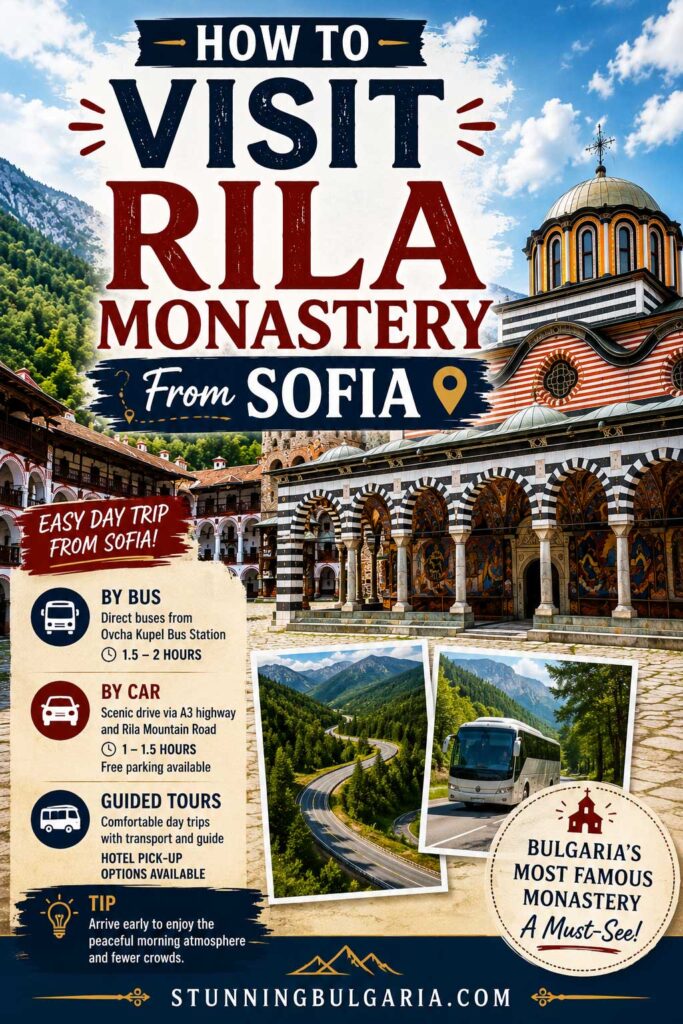
Rila Monastery is about 120 km (75 miles) from Sofia, making it possible to visit on a day trip from the Bulgarian capital. For most travelers, driving or joining an organized tour is the simplest option.
By Car
Traveling by car gives you the most flexibility, particularly if you want to explore more of the Rila Mountains.
From Sofia, follow the main route south toward Blagoevgrad and Kulata, then turn toward Kocherinovo and Rila. From the town of Rila, the road continues into the mountains toward the monastery.
The drive generally takes around 2 hours, although traffic and weather conditions can affect travel time.
Driving also makes it much easier to combine Rila Monastery with nearby attractions or spend additional time around Saint Ivan of Rila’s cave.
By Bus
Public transportation to Rila Monastery can be more complicated because routes and departure times may change seasonally.
If you plan to travel by bus, check the current schedule shortly before your trip rather than relying on departure times published in older travel guides.
Depending on current services, your journey may involve traveling to a nearby town and connecting with local transportation to the monastery.
By Organized Tour or Shuttle
For visitors staying in Sofia without a car, an organized day tour or shuttle is often the easiest way to reach Rila Monastery.
Many tours leave Sofia in the morning and return later the same day. Some itineraries combine the monastery with another attraction, allowing you to see more of the region without arranging separate transportation.
Before booking, check how much free time at Rila Monastery is included. A very short stop may be enough to see the courtyard and church, but not enough for the museum, historic kitchen, or nearby cave.
By Train
There is no railway station at Rila Monastery, so traveling entirely by train is not possible.
You can travel by rail from Sofia toward towns in the region, but you will still need a bus, taxi, or another form of transportation for the final journey into the mountains.
For that reason, taking the train is generally less convenient than driving, using a shuttle, or joining a day tour.
Which Option Is Best?
If you want maximum flexibility, driving is the best option. You can arrive earlier, stay as long as you like, visit Saint Ivan’s cave, and make additional stops along the way.
If you don’t want to drive in Bulgaria, a day tour or shuttle from Sofia is usually the easiest alternative.
Whichever option you choose, check current road conditions and transportation schedules before leaving, particularly when visiting during winter or periods of bad weather in the Rila Mountains.
Best Time to Visit Rila Monastery
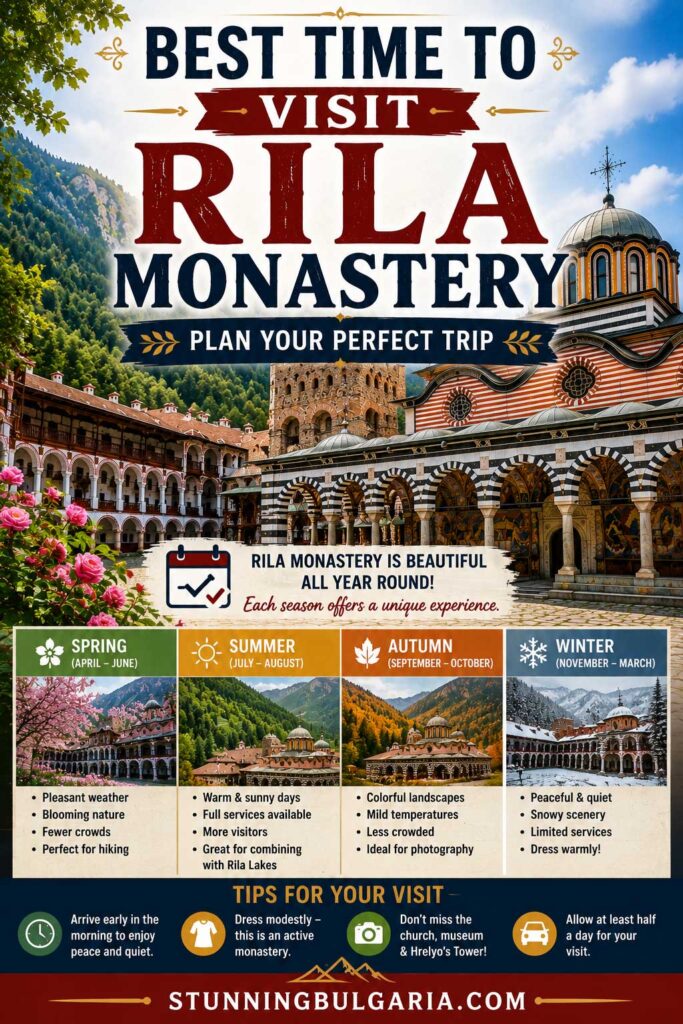
Rila Monastery can be visited throughout the year, and each season gives the surrounding Rila Mountains a completely different atmosphere. For most travelers, however, late spring through early autumn offers the easiest conditions for exploring both the monastery and nearby attractions.
Spring
Spring brings fresh greenery, flowing mountain streams, and fewer visitors than the busiest summer months.
The weather can still be unpredictable at this elevation, especially earlier in the season, so bring an extra layer and be prepared for rain.
Summer
June through September is the most convenient period for most visitors. Days are generally warmer, the surrounding mountains are green, and conditions are better for combining the monastery with walks or other outdoor attractions.
Summer is also the busiest period. If you want to experience the courtyard before larger groups arrive, try to visit earlier in the morning.
Autumn
Autumn is one of the most beautiful times to visit Rila Monastery.
The forests surrounding the complex turn shades of yellow, orange, and red, creating a spectacular backdrop for the monastery’s striped arches and domes.
September and early October can be particularly rewarding if you want pleasant hiking conditions with fewer peak-summer crowds.
Winter
Snow transforms Rila Monastery into an entirely different place. The white mountains, stone walls, and quiet courtyard can make a winter visit especially atmospheric.
However, remember that the monastery sits more than 1,100 meters above sea level. Snow, ice, colder temperatures, and changing road conditions can make winter travel more challenging.
Check the weather and road conditions before driving into the mountains.
What Is the Best Time of Day to Visit?
If possible, arrive early in the morning.
You’ll generally have a better chance of experiencing the monastery before the busiest part of the day, and the quieter atmosphere makes it easier to appreciate that Rila Monastery is still an active religious site rather than simply a tourist attraction.
Late afternoon can also be pleasant after many day-trip groups begin leaving.
If photography is important to you, allow enough time to walk around the courtyard more than once. The arches, frescoes, church, and surrounding mountains look noticeably different as the light moves across the complex.
Rila Monastery Opening Hours and Entrance Fees
One of the best things about visiting Rila Monastery is that you can enter the main monastery complex and explore its famous courtyard without paying a general admission fee.
However, some individual attractions within the complex may require a separate ticket.
Is Rila Monastery Free to Visit?
Access to the main courtyard and monastery complex is generally free. Visitors can walk through the gates, admire the architecture and exterior frescoes, and enter the main church when it is open to visitors and religious services permit.
Separate admission may apply to attractions such as the Rila Monastery Museum, Hrelyo’s Tower when accessible, and other exhibitions or historic areas.
Because ticket prices and access arrangements can change, check the monastery’s current visitor information before your trip rather than relying on prices published years earlier.
Rila Monastery Opening Hours
The monastery itself is an active religious complex and is generally accessible daily, but individual museums, towers, churches, and exhibitions may operate on different or seasonal schedules.
Opening hours can also change around religious holidays, special services, winter conditions, or monastery events.
If seeing a particular attraction such as Rafail’s Cross is important to you, verify that part of the complex will be open on the day you plan to visit.
Can You Attend a Religious Service?
Yes. Rila Monastery remains an active Bulgarian Orthodox monastery, and religious services continue to be held there.
Visitors may be able to attend a service, but remember that you are entering a place of worship rather than a tourist performance. Remain quiet, dress respectfully, avoid disrupting worshippers, and follow instructions regarding photography.
Before You Go
Check current opening hours, ticket prices, photography rules, and access restrictions shortly before your visit. This is particularly important if you are traveling a long distance specifically to see the museum, Hrelyo’s Tower, or another ticketed part of Rila Monastery.
The courtyard alone is impressive, but allowing time for the church, museum, historic architecture, and surrounding area will give you a much better understanding of why Rila Monastery is one of Bulgaria’s most important landmarks.
What to Wear When Visiting Rila Monastery
Rila Monastery is an active Bulgarian Orthodox monastery, so visitors should dress respectfully, particularly when entering the main church and other religious spaces.
You don’t need formal clothing, but your outfit should be appropriate for a place of worship.
Dress Modestly
Avoid very short shorts, mini skirts, revealing tops, and clothing that exposes too much of the shoulders or chest.
A simple T-shirt or blouse with trousers, jeans, or a reasonably long skirt is appropriate for most visitors. If you’re visiting during hot summer weather, carrying a light layer or scarf can be useful before entering religious spaces.
Wear Comfortable Shoes
Comfortable shoes are a good idea even if you plan to stay mainly within the monastery.
You’ll be walking across stone surfaces, climbing steps, and exploring different parts of the complex. If you plan to continue to the Cave of Saint Ivan of Rila, proper walking shoes become even more important because the route includes forest paths and uneven terrain.
Bring an Extra Layer
Don’t assume that temperatures at Rila Monastery will be the same as in Sofia.
The monastery sits at roughly 1,150 meters (3,770 feet) above sea level, and the mountain environment can feel noticeably cooler, particularly in the morning, evening, spring, and autumn.
A light jacket or sweater is useful even when Sofia feels warm.
Be Respectful Inside the Church
Keep your voice low, silence your phone, and avoid disturbing worshippers or religious services.
Photography rules can vary between different parts of Rila Monastery, so always look for posted signs and follow instructions from monastery staff.
Ultimately, you don’t need to overthink what to wear. Comfortable, modest clothing and good walking shoes will work for most visits while showing appropriate respect for one of Bulgaria’s most important religious sites.
How Much Time Do You Need at Rila Monastery?
For most visitors, plan to spend around 2 to 3 hours at Rila Monastery. That gives you enough time to explore the courtyard, admire the frescoes, visit the main church, and see some of the monastery’s most important historic areas without rushing.
How long you actually need depends on what you want to see.
1 Hour: A Quick Visit
If Rila Monastery is one stop on a busy day trip, you can see the main highlights in about an hour.
Walk around the central courtyard, see the Church of the Nativity of the Virgin, examine the exterior frescoes, and take a closer look at Hrelyo’s Tower.
You’ll get a good first impression, but you will miss much of what makes the monastery interesting beyond its famous architecture.
2–3 Hours: Best for Most Visitors
Around 2 to 3 hours is a much better choice for a first visit.
This gives you time to explore the monastery at a relaxed pace, enter the church, visit the museum to see Rafail’s Cross, look at the historic kitchen and residential galleries where accessible, and spend some time simply enjoying the mountain setting.
It also leaves room for photography without turning your visit into a race between attractions.
Half a Day: For the Full Experience
Consider allowing half a day if you are particularly interested in Bulgarian history, Orthodox art, architecture, or photography.
Extra time also makes it possible to explore beyond the monastery itself.
One of the best additions is the Cave of Saint Ivan of Rila, located a few kilometers from the main complex. Visiting the cave and its surrounding forest gives you a much better understanding of the remote mountain environment in which the story of Rila Monastery began.
Don’t Rush the Courtyard
Even if you have limited time, resist the temptation to arrive, photograph the famous courtyard, and immediately leave.
Some of the most memorable details at Rila Monastery are easy to overlook: tiny scenes within the frescoes, carved wooden balconies, stone staircases, views beneath the arches, and the contrast between medieval Hrelyo’s Tower and the colorful 19th-century church.
For a first visit, 2 to 3 hours is the sweet spot. Add more time if you want to visit Saint Ivan’s cave or explore the surrounding Rila Mountains.
What Else to See Near Rila Monastery
A visit to Rila Monastery doesn’t have to end when you walk through the monastery gates. The surrounding Rila Mountains contain beautiful forests, hiking routes, religious sites, and some of Bulgaria’s best-known natural attractions.
If you have extra time, consider adding one or more of these places to your trip.
Cave of Saint Ivan of Rila
The Cave of Saint Ivan of Rila is the most meaningful addition to a monastery visit.
Located a few kilometers from the main complex, the cave is traditionally associated with the period when Saint Ivan lived as a hermit in the mountains. A short forest walk leads to the cave and the nearby Church of the Dormition of Saint Ivan of Rila.
Visiting both places helps connect the enormous monastery you see today with its remarkably humble beginnings.
Stob Earth Pyramids
The Stob Earth Pyramids are unusual natural rock formations near the village of Stob, making them an easy additional stop when traveling to or from Rila Monastery by car.
Weathering and erosion have shaped the reddish earth into pinnacles, ridges, and steep formations, some topped by large stones.
A hiking trail leads through the landscape to viewpoints over the surrounding countryside. If you enjoy unusual geological formations, this is one of the most interesting stops in the area.
Seven Rila Lakes
The Seven Rila Lakes are among Bulgaria’s most famous mountain destinations.
The seven glacial lakes sit high in the Rila Mountains and are connected by popular hiking routes with spectacular views.
Although Rila Monastery and the Seven Rila Lakes are both in the Rila Mountains, don’t assume they are right beside each other. Traveling between them takes time, and visiting both properly in one day can create a rushed itinerary.
If hiking is one of the main reasons for your trip, consider giving the lakes their own day.
Also Read: Seven Rila Lakes: One of Bulgaria’s Most Beautiful Mountain Destinations
Rila Monastery Nature Park
You don’t necessarily need another famous attraction to enjoy the area.
Rila Monastery Nature Park surrounds the monastery with forests, rivers, mountain slopes, and hiking trails. Spending even a little time outside the main tourist complex gives you a better sense of the landscape that shaped the monastery’s history.
The Town of Rila
On the road between the monastery and the main highway is the small town of Rila.
Most visitors pass through quickly, but the journey itself helps show just how far into the mountains the monastery lies. The road gradually leaves the more populated valley behind before following the Rilska River toward the monastery.
If you have your own car, combining Rila Monastery, Saint Ivan’s cave, and the Stob Earth Pyramids makes a particularly manageable day in this part of Bulgaria.
Frequently Asked Questions About Rila Monastery
Why Is Rila Monastery Famous?
Rila Monastery is famous for its more than 1,000 years of history, spectacular Bulgarian National Revival architecture, colorful frescoes, medieval Hrelyo’s Tower, religious treasures, and connection with Saint Ivan of Rila. It has been a UNESCO World Heritage Site since 1983 and remains one of Bulgaria’s most important Orthodox monasteries.
Who Founded Rila Monastery?
Rila Monastery traces its origins to Saint Ivan of Rila, a 10th-century Bulgarian hermit. His followers established a monastic community in the Rila Mountains that eventually developed into the monastery.
How Old Is Rila Monastery?
The origins of Rila Monastery date to the 10th century, making its history more than 1,000 years old. Most of the buildings visitors see today are considerably newer because the complex was destroyed and rebuilt several times.
Is Rila Monastery Worth Visiting?
Yes. Rila Monastery is one of the best places to visit in Bulgaria, particularly if you are interested in history, architecture, Orthodox art, photography, or mountain scenery. Its location also makes it a popular day trip from Sofia.
Is Rila Monastery Free?
Visitors can generally enter the main monastery complex and courtyard without a general admission fee. Some individual attractions, including museum exhibitions and certain historic areas, may require separate tickets.
How Far Is Rila Monastery From Sofia?
Rila Monastery is approximately 120 km (75 miles) south of Sofia by road. Driving usually takes around two hours, although travel time depends on traffic, weather, and road conditions.
Can You Visit Rila Monastery on a Day Trip From Sofia?
Yes. A Rila Monastery day trip from Sofia is very manageable by car, shuttle, or organized tour. Allow a full day if you also want to visit nearby attractions rather than rushing through the monastery.
How Long Should You Spend at Rila Monastery?
For most first-time visitors, 2 to 3 hours is a comfortable amount of time. Allow longer if you want to explore the museum carefully or visit the nearby Cave of Saint Ivan of Rila.
Can You Take Photos at Rila Monastery?
Photography is possible in many outdoor areas, including the famous courtyard, but restrictions may apply inside churches, museums, and other religious or exhibition spaces. Check posted signs and follow instructions from monastery staff.
Can You Stay Overnight at Rila Monastery?
The monastery has historically provided accommodation for pilgrims and visitors, but availability and booking arrangements can change. If you hope to stay overnight, contact the monastery or check current official visitor information before traveling.
What Should You Wear to Rila Monastery?
Wear modest clothing appropriate for an active Orthodox monastery. Avoid overly revealing clothing, particularly when entering churches, and choose comfortable shoes if you plan to explore the surrounding area.
What Is the Best Time to Visit Rila Monastery?
Late spring through early autumn offers the easiest weather for most visitors, while autumn brings particularly beautiful colors to the surrounding forests. Winter can be spectacular as well, but snow and mountain road conditions require more preparation.
Is Rila Monastery Worth Visiting?
Yes, Rila Monastery is absolutely worth visiting, especially if this is your first trip to Bulgaria.
There are more than a thousand years of history here, but you don’t need to be interested in monasteries or religious history to appreciate the place. The journey into the Rila Mountains, the moment you walk through the heavy gates, and the first view of the striped arches, colorful frescoes, medieval tower, and surrounding peaks make the monastery memorable even before you know its story.
What makes Rila particularly special is how many different sides of Bulgaria come together in one place. You can see medieval history, Bulgarian National Revival architecture, Orthodox traditions, extraordinary craftsmanship, and mountain scenery within the same complex.
Don’t treat it as a quick photo stop if you can avoid it.
Walk beneath the fresco-covered arches. Step inside the church. Look closely at Hrelyo’s Tower. Visit the museum and see Rafail’s Cross. And if you have extra time, continue into the forest toward Saint Ivan of Rila’s cave, where the story began more than a thousand years ago.
After exploring these 20 fascinating facts about Rila Monastery, it becomes easier to understand why this remote mountain sanctuary grew into one of Bulgaria’s greatest cultural treasures.
If Rila is part of a larger trip around the country, continue planning with our guide to the Top 10 Places to Visit in Bulgaria and discover more of the landscapes, historic towns, monasteries, and landmarks that make Bulgaria such a fascinating place to explore.
Do You Know More Interesting Facts About Rila Monastery?
Have you visited Rila Monastery? If you know another fascinating story, historical detail, or local legend that belongs on our list of facts about Rila Monastery, we’d love to hear it.
Share your experience in the comments below, or tag @stunningbulgaria on Instagram and use #stunning_bulgaria so we can see your photos from Rila.
Planning more adventures around Bulgaria? Here are a few more guides to inspire your next trip:
- Top 10 Places to Visit in Bulgaria — discover some of the country’s most memorable historical, cultural, and natural attractions.
- Best Places for Backpackers in Bulgaria — ideas for exploring more of Bulgaria independently and on a budget.
- Seven Rila Lakes: One of Bulgaria’s Most Beautiful Mountain Destinations — continue exploring the spectacular landscapes of the Rila Mountains.